New Training Classes beginning January 24th

by Caroline Gutman on 11 Jan 2012

Following our latest release, we’ve updated the training classes to include a business focus. We’ll be rolling out the classes beginning Tuesday, January 24th:

Understanding the AWS Platform – Tuesdays at 10:00am – 45mins


Adding Value and Credibility to your Advice – Tuesdays at 11:00am – 30mins

Course Content:

  • Morningstar Qualitative Analyst Ratings
  • Viewing underlying portfolio holdings
  • Creating an auditable trail
  • Saving Searches
  • Creating investment lists
  • Understanding the Morningstar Style Box

Building Portfolios – Wednesdays at 10:00am – 30mins

Course Content:

  • Finding the right funds to fit an asset allocation
  • Defining the Asset Allocation
  • Building models
  • Tracking quick portfolios over time

Creating an Investment Process – Thursdays at 10:00am – 30mins

Course Content:

  • Reviewing client’s current positions
  • Risk Profiling
  • Selecting a target Asset Allocation
  • Allocating funds within a portfolio

New Features and Quick Tips – Thursdays at 10:30pm – 30 mins

Course Content:

  • New Features in latest release
  • Quick Tips and Suggestions

Visit the Training Page (tab at the top) to see the new schedule.

To register, click here:

https://www.formstack.com/forms/?1156941-V2J4VbuM3h

Posted in: Morningstar,

Reviewing the ETP Market in 2011, a Look Into 2012

by Caroline Gutman on 06 Jan 2012

The first Morningstar ETF webinar of 2012 will provide an overview and assessment of the passive investing industry in 2011, a look at the hype around ETP ‘bogeymen’ and supposed rogue trading, and also provide insights into what the new year holds for ETP investors.

Join Morningstar analysts on January 25 at 3.00pm (GMT) for a live online discussion. Register in advance to pose your own questions; listen again on demand to review the presentation slides.

Topics include:
– 2011: The Year in Figures
– The Year of the ETP Bogeyman
– What Investors Told Us About ETPs in 2011
– A Look Forward Into 2012

Click here to register for this upcoming webinar.

If you are not already registered with BrightTALK you will need to do so to attend the webinar; registration is fast and free, and need only be completed once to gain access to all Morningstar’s ETP and investment trust webinars.

Missed our previous ETP webinars? Catch up here.

Posted in: Events, Morningstar,

Thanks

by Caroline Gutman on 23 Dec 2011

From the Adviser Workstation team,

We’d like to thank all of our readers this year, and wish you a wonderful holiday and a happy New Year.

We’ll start off 2012 with a user forum in Southampton on January 18th at the Jury’s Inn. Details to follow, hope to see you there.

Register here for the User Forum

Posted in: Morningstar,

Adviser Workstation New Features

by Caroline Gutman on 15 Dec 2011

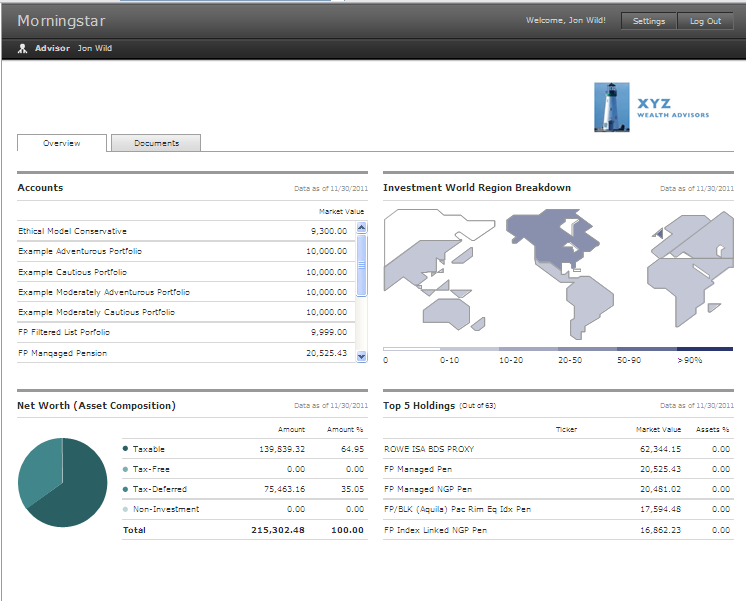
This weekend we’re rolling out a new release of Adviser Workstation. With it come a number of great new features including seamless importing, advanced charting, and customizable web portals.

Optional client overview

Webportal with customizable client overview

You can find the full list of new features below.

We’ll have training sessions over the next few weeks to introduce you to all the updates and help implement them into your practice:

Monday 19/12 at 10am

Tuesday 20/12 at 10am

Thursday 22/12 at 10am

Tuesday 3/1 at 2pm

Wednesday 4/1 at 10am

Friday 6/1 at 2pm

New Features

Positional History Tracking – we have enabled the ability to track changes over time within your model portfolios and client portfolios, without the need to track the full transactional history.

Flexible Portfolio Report – The snapshot report will have options for you to pick and choose which sections you want to include.  This is also enabled within batch reporting to allow for simpler reporting options

New, Improved Webportal – Now with an overview of investments screen including list of client portfolios with valuations, asset breakdowns and geographic breakdowns.  Client document upload feature, so clients have a way of providing signed documentation back to you with audit trail.

Quick access to Efficient Frontier – Under the main menu you will have quick access to the efficient frontier tool to allow you to quickly check your client’s portfolios risk and return.  There is also a flexible report option.

Transact seamless import – for advisers using the Transact platform, you can now bring in your data directly to adviser workstation.  You will need to have a data transfer agreement set up with Transact.

Income Charting – new charts that provide analysis on income

Income vs. No Income Chart: View the effect of reinvesting dividends on performance

Holdings Similarity Charts – charting tool that helps provide analysis on how similar the underlying holdings are to index tracked – this feature helps to highlight closet tracker funds.

If you would like to learn more about any of the above we are holding special traning sessions on the following dates, use the link to register:  https://www.formstack.com/forms/?1147562-V2J4VbuM3h

Posted in: Morningstar, Quick Tips,

CancerIFA Profile

by Caroline Gutman on 09 Dec 2011

(Guest posting by CancerIFA)

Cancer is the most powerful word in the English language. Although medical science has dramatically improved recovery from most cancers, and terminal cancer has become largely an old person’s disease, people of all age groups nevertheless suffer from cancer, and everyone remains fearful of even the word ‘cancer’.

There is currently a range of anti cancer treatments, anti cancer drugs, diets and support services, and Cancer IFA is a new service principally for members of Employee Benefits Schemes who are terminally ill with cancer; Cancer IFA is therefore also a new support service for IFAs.

The story of Cancer IFA

The founder of Cancer IFA is George Emsden, a retired banker and financial adviser who four years ago had a sore throat that wouldn’t go away, that was ultimately diagnosed as throat cancer.

Cancer diagnosis is always a shock, but probably less so for George who at 19 years old saw his mother die of cancer, and a succession of friends and family thereafter. When George was diagnosed, he received lots of advice from doctors and charities on how to deal with friends and family, but no advice on having a big end of life experience. George loves Latin-American dancing, and he wanted a big end of life experience visiting Argentina, the home of the tango

To pay for his big end of life experience, he needed to know how much a two month, or three month tour of Argentina would cost, and how much his insurance policies pensions and other financial assets were worth. As a financial adviser, George already had the skills to value his financial assets, but most people don’t, and so the idea for a new business was born.

A service that helps cancer sufferers and also IFAs

Early diagnosis, a positive attitude, and the wonders of medical science have assured George has since recovered from cancer. And as he openly speaks about his cancer experience, many cancer sufferers and other people have described his story as an inspiration.

However, when relating his story to financial and pension advisers, George noticed they seemed uncomfortable advising clients recently diagnosed with terminal illness. Of course, George had no such discomfort, and above all felt a calling to help other cancer sufferers. So Cancer IFA was born as a service that assists the clients of financial and group pension advisers to find out how big an end of life experience they can have.

What is Cancer IFA and how does it work?

  1. Cancer IFA is a unique service for terminally ill cancer sufferers
  2. It helps sufferers to articulate, and ultimately to experience the dream of a last holiday or even to organise a final gift to the community
  3. The service is offered to sufferers and their spouses, who are members of a group pension or employee benefits scheme
  4. Cancer IFA provides the service by listening to the sufferer’s end of life dreams
  5. During two telephone meetings, the sufferers’ priorities and inspirations are carefully listened to, analysed and noted as options
  6. Cancer IFA then researches the cost of those options compared to the value of the sufferer’s assets, and recommends a ‘doable’ end of life dream experience

As a retired financial adviser, George Emsden is used to listening to people and comparing people’s dreams with their assets, and having experienced cancer, George is also able empathise with cancer sufferers

But Cancer IFA is neither a financial advice service, nor a holiday organiser! Rather, it is a pastoral service that researches ‘how big an end of life experience a cancer sufferer can have’, and therefore Cancer IFA, is quite different from the advice given by cancer charities and doctors

In summary, Cancer IFA is an inspiration

Cancer IFA is ‘open for business’ and every year will pay 5% of turnover to cancer charities. The Cancer IFA name is trademarked, and the service is offered direct to clients or through employee benefits schemes.

Cancer IFA is therefore a service offered via IFAs who lack the expertise to work with the terminally ill and want an expert to work with clients recently diagnosed with cancer

In summary, Cancer IFA is an inspiration for cancer sufferers who want a big end of life experience and need an empathetic and qualified professional to show how big an end of life experience they can have.

(Guest posting by CancerIFA)

For further information, contact:

C Morrison

Partner

Callum@cancerifa.com

07899 661 281

Posted in: Morningstar,
Enhanced Morningstar Analyst Ratings for Funds

by Caroline Gutman on 23 Nov 2011

Morningstar launched its analyst-driven ratings for funds in Europe and Asia in February 2009. Since then, our team has published ratings and in-depth reports on 1,145 funds, published in eight languages. We seem to have struck a chord with you—collectively the reports have been downloaded more than 2 million times. But we think we can make our work even better. To do that, today we are launching a revised Morningstar Analyst Rating scale that will be used by our 90+ qualitative fund analysts around the world, and new, even more-in-depth reports to complement the ratings will arrive in early 2012.

**Out with the Old, in with the New
** The principle change is to the ratings scale we use to express our analysts’ opinions.

The new Morningstar Analyst Rating scale is as follows:

Positive Ratings:

  • Gold: Best-of-breed fund that distinguishes itself across the five pillars and has garnered the analysts’ highest level of conviction;
  • Silver: Fund with notable advantages across several, but perhaps not all, of the five pillars—strengths that give the analysts a high level of conviction;
  • Bronze: Fund with advantages that outweigh any disadvantages across the five pillars, and sufficient level of analyst conviction to warrant a positive rating;

Neutral: Fund that isn’t likely to deliver standout returns, but also isn’t likely to significantly underperform; and

Negative: Fund that has at least one flaw likely to significantly hamper future performance, and is considered an inferior offering to its peers.

Previously, we used a symmetric five-tier scale that included two positive ratings, a neutral rating, and two negative ratings (Elite, Superior, Standard, Inferior, and Impaired). The new scale bundles our negative views into a single rating and we now have three levels—Gold, Silver, and Bronze—to provide an additional level of detail in our positive ratings. This gives investors more granular insight into our views on the funds they are likeliest to own and allows us to more clearly signal to investors whether our conviction level on positively-rated funds is growing stronger or weaker.

Rest assured, however, that there is no change to our research approach: Our analysts continue to rate funds based on their conviction in a fund’s ability to outperform its benchmark or peers over the long term. To arrive at a rating, they evaluate five key pillars our experience has shown us are critical to a fund’s ability to succeed: People, Process, Parent, Performance, and Price. For more information on the methodology, click here. There is also no change to our business model: As before, we do not accept payment to rate funds, and the ratings decisions lie solely in the hands of our independent analysts.

**Coming Soon: Enhanced Reports
** When we launched our ratings in 2009, we believed it was essential to provide investors with an in-depth report to give them full transparency on the rationale for the ratings decision taken, and our views on each of the five pillars we evaluate. That report is still in place today, but in early 2012, we will replace it with a greatly enhanced, more in-depth format with even richer proprietary analytics and data to support our analysts’ work. Among these will be a summary scorecard for the five pillars, with each pillar graded as positive, negative, or neutral, to provide even greater transparency around the rationale for the rating.

The purpose of our research is to help you, our users, make better investment decisions and the new rating and reports have been designed with this goal kept constantly in mind. The new ratings are now available in our products, including this web site. As always, we value your feedback, so please let us know what you think in the comments section below.

By Christopher J. Traulsen

Posted in: Morningstar, Press Releases, Research,

Web-based research, planning, portfolio management and client reporting tool allows advisers to analyse a client’s attitude to risk and existing portfolios

Asset allocation is the foundation for building well-diversified portfolios. It offers a strategic approach to portfolio design by combining asset classes such as stocks, bonds and cash to meet an investor’s goals. For advisers – whether running your own asset allocation strategies or taking guidance from ready packaged asset models – it is of vital importance that the data powering your software solution is based on sound methodologies and a reliable set of expectations for returns, risk, and correlation.

Morningstar’s asset allocation tools draw heavily on the work of Ibbotson Associates, a unit of the Morningstar Investment Management division recognised worldwide for its academic research into asset allocation. Back in the early 1970s, in what would prove to be ground-breaking research, Ibbotson founder Roger G Ibbotson, along with Rex Sinquefield, researched and assembled the annual returns for several US asset classes dating back to 1926.

This seminal work allowed for the analysis of risk and return characteristics of different asset classes and today serves as a foundation for much of the modern asset allocation used in Morningstar’s software solutions for advisers.

Efficient frontier

Morningstar Adviser Workstation is a web-based research, planning, portfolio management and client-reporting platform. It provides access to Ibbotson asset allocation, capital market assumptions and asset models, and allows advisers to analyse a client’s attitude to risk and existing investment portfolios. The platform’s embedded risk-profiling and asset allocation tools are powered by models developed by Ibbotson Associates.

Inputs to asset allocation models typically include three types of assumptions about the behaviour of asset class returns: (1) the expected return of each asset class, (2) the volatility of the returns on each asset class, and (3) the correlation between the returns of each pair of asset classes. Diversification helps reduce portfolio risk; as the number of distinct asset classes in a portfolio increases, the total risk or volatility can be decreased up to a point without sacrificing expected return.

If risk cannot be further reduced without sacrificing expected return, the portfolio is said to be efficient. The set of all efficient portfolios is called the efficient frontier. In theory, investors should only choose among efficient frontiers.

The correlations among asset classes determine the degree to which risk can be reduced through diversification. The lower the correlations, the greater are the potential diversification benefits. Morningstar Adviser Workstation contains a tool known as a mean-variance optimiser that calculates the efficient frontier from the asset class assumptions. It can also impose various constraints on the portfolios selected, such as placing a maximum on equity exposure, to help ensure diversification or impose limits that the adviser and investor agree are needed.

Research has shown that expected return assumptions have great impact on the composition of efficient portfolios. Ibbotson Associates developed an approach to creating excepted return assumptions called the building-block approach. This combines current market data, such as bond yields, with historical performance relationships to build expected return assumptions that researchers at Ibbotson believe provide the best estimate of what market participants are expecting future long-term returns to be.

To assist your work in proposing the correct asset allocation mix based on your client’s risk profile, the Morningstar platform provides five strategic asset allocation guidance models that are aligned to the risk profiles generated by the embedded Morningstar risk tolerance questionnaire. Alternatively, the embedded methodology also allows advisers to create their own asset models based on Morningstar Investment Management’s capital market assumptions.

If choosing the latter, the asset allocation mix can be constructed through analysis of the various asset classes, their behaviours and how they blend.

The adviser is then able to match up investments to a proposed asset allocation to construct a portfolio. To build the portfolio will require the ability to understand the asset allocation breakdown of the investments being selected.

At Morningstar we insist on the collection of full holdings data from fund providers. Morningstar then classifies funds according to their asset breakdowns, enabling advisers to search for the funds that meet their needs with ease. This means that when you are looking at constructing a portfolio, you will do so based on comprehensive data that fits the asset models you are using.

All of the asset allocation tools described here are packaged into the investment advice process of Morningstar Adviser Workstation to enable advisers to run their clients through an investment process.

They can be combined with other research tools and data available through the platform, including Morningstar and OBSR’s forward-looking analyst ratings and research reports that provide in-depth analysis of approximately 700 funds available to investors in the UK.

###

By Anastasia Georgiou and Paul Malone
Read more: http://www.investmentweek.co.uk/investment-week/feature/2124253/morningstar-workstation-aid-asset-allocation-decision/page/2#ixzz1eLW4qQrq

Posted in: Morningstar, Research,

What is changing?

The Morningstar RatingTM for closed-end funds aims to measure a manager’s or team’s skill based on their performance. It is a backward-looking measure, calculated using the last 3-, 5-, and 10-years of performance. Until now, the rating calculation has used the fund’s closing market price, but starting in November 2011 the calculation will use the fund’s Net Asset Value (NAV) instead.

In addition, Morningstar will no longer calculate the Morningstar Rating for closed-end funds according to their Association of Investment Company (AIC) sectors. Instead, we will compare London-listed investment companies against their peers in the Morningstar Category system, which is available at (link).

Why is Morningstar making these changes?

We believe that using a fund’s NAV in its Morningstar RatingTM calculation is superior to closing market price as a measure of risk-adjusted performance given that listed funds are subject to influences outside the manager’s control, such as market sentiment. Moving to a NAV calculation therefore brings the closed-end fund rating methodology closer in line with the open-end fund rating methodology—which also uses NAV in its Rating calculation—allowing investors to more readily compare the performance of a selection of funds, irrespective of the funds’ legal structures.


Why are Morningstar’s Category definitions a more useful way to categorise funds?

For the purposes of calculating a Morningstar Rating, we believe Morningstar categories offer investors better granularity and peer group analysis because they are based on a fund’s holdings. Further, because they incorporate all mutual funds available for sale in the UK—both closed- and open-end funds— they result in a larger and more representative peer group for comparison. This is important in the calculation of the Morningstar Rating, which requires a peer group of a certain size for a Morningstar Rating to be viable. As a result of categorising closed-end funds in the Morningstar Category, we can now calculate ratings for more funds than before.

For example, JPMorgan Chinese Investment Trust sits in the Country Specialist Asia Pacific AIC sector. This sector comprises 14 listed funds investing in quite different areas geographically—for example, Vietnam, India, and Thailand—so a rating against this peer group is of limited value. When we compare this fund against its peers in the Morningstar Chinese Equity Category, which includes not just investment trusts, but open-end and exchange traded funds too, that comparison spans 227 fund share classes, all of which invest in Chinese equities. This makes it a far more meaningful comparison as a true like-for-like basis.

Which funds are affected by this change?

The Morningstar Ratings for all investment companies listed on the London Stock Exchange are affected by this methodology change.

How is gearing incorporated into the calculation?

The Morningstar Rating for closed-end funds is calculated with risk-adjusted performance, and as gearing tends to increase the volatility of a fund’s returns, it also increases risk. In our methodology, we penalise funds for taking risk, but reward them if they do it well and add value for investors. So if a manager uses gearing well, then although there will be a penalty for taking extra risk, there is also a reward for making it work. This means investors can still compare closed- and open-end funds on a like-for-like basis.

Are there any closed-end funds that are not eligible for a Morningstar Rating?

Yes. There are some Morningstar categories for which we don’t rate closed-end funds—for example, Property – Direct Europe, as these funds are investing in bricks and mortar and not equities. The Morningstar Category system, available at LINK, details which fund categories are not eligible for a Morningstar Rating.

How many closed-end funds now receive a Morningstar Rating?

254 (as at 31 October 2011)


Does the Morningstar Rating for closed-end funds take transaction costs into account?
No. Closed-end funds are shares listed on a stock exchange, so they are subject to brokerage fees. The amount of this fee varies by broker and by size of the trade. As a result, any such fee we might factor in would be arbitrary. Transaction fees are not therefore incorporated in the calculation of the Morningstar RatingTM for closed-end funds.

**Does the revised Morningstar Rating methodology for closed-end funds also apply to ETFs?
** No. As open-end funds, exchange-traded funds already receive a Morningstar Rating according to their Morningstar Category.

Posted in: Morningstar, Research,

Join Morningstar’s  Jackie Beard for a panel discussion on the challenges faced by an investment board at 1pm on 14 September 2011.  This is particularly  relevant in the current environment, with the ever-increasing burden upon non-executive directors as stewards of shareholder capital.  The session will also look at why their role gives the fund a distinct advantage over its open-end counterparts and the different ways in which they can add value for shareholders.

Jackie would like to make sure this session addresses any concerns that you, our advisers, have, and to answer the questions that you want answered. So we  invite you to post any questions on corporate governance of closed-end funds that you may have on the blog between now and 13 September.   The panel really is an outstanding line up with

Scott Dobbie CBE; Gill Nott OBE; Hugh Aldous; Peter Arthur and James Saunders Watson. It’s not often one gets the chance to question such an esteemed group of people, so don’t miss this opportunity. While it’s unfair to single out individual panel members, Ms Nott’s OBE was for services to financial education and Mr Dobbie’s CBE for services to financial regulation.

Register for the event by clicking here.

Posted in: Events, Morningstar, Research,

Morningstar Will Provide Sector Monitoring for IMA

by Jon Standring on 29 Jul 2011

As you may have seen in the financial media recently, Morningstar UK has been appointed Sector Monitoring Organisation to IMA.

Following a successful bid, and starting on 1st October this year, Morningstar UK will be managing the data collection, processing, and reporting of all portfolio holdings for all open-end funds available to investors in the UK that are classified to IMA sectors. This will include considerable data monitoring, collection, and reporting work around fund derivatives holdings, which we believe to be a particularly crucial as the use of derivatives in investment management continues to rise and issues around their transparency grow.

In this regard, we’ll be working with the IMA to develop rules for monitoring funds that are not suited to long-only portfolio monitoring, including the identification of the increasing number of funds using derivatives for investment purposes beyond efficient portfolio management and the development of a recommended disclosure standard for derivatives holdings.

The collection and analysis of portfolio holdings is at the core of who we are and what we do. For the past 10 years, we’ve led the collection and analysis of full fund portfolio holdings across the UK and Europe based on our fundamental belief that investors need transparent and consistent analysis of full portfolio holdings in order to fully understand their investments.  We very much look forward to bringing this expertise to bear in our additional capacity as Sector Monitoring Organisation to the broader industry.

Posted in: IFA News and Commentary, Morningstar,