On Wednesday 13 June it’s the next in our series of webinars from the Best Advice: Closed-end Fund Forum group.  This month our topic is centred around some of the quirks of investment trusts and how to manage these.  Advisers have traditionally been put off investment trusts by their perceived complexity. In reality, closed-ended funds are no more complex than open-ended, but it is worth examining the ‘tricks of the trade’ and how expert investors in investment trusts manage the quirks of investment trusts, notably discounts, liquidity and governance.

We will also be talking through how some of our panel members use investment trusts and where open-ended funds might be more appropriate.

I’m delighted to be joined on the panel by Julian Cane, manager of F&C Capital & Income (FCI) and Peter Walls, of small-cap specialists Unicorn, who are representing the investing side; James Moseley, head of sales at Winterfloods and representing the broker’s perspective; and William Hemmings, Aberdeen’s Head of Closed-end Funds. One of William’s responsibilities is liaison with the boards of Aberdeen’s funds so he brings yet another perspective to the table.

We’d love to hear the questions you want answered. You can submit questions in advance through the ‘feedback’ form at the bottom of this page or by emailing me directly.

Please join us in our discussion by attending here: http://www.brighttalk.com/r/dQB

If you are unable to join the live webinar, you can watch again on demand afterwards. During the live event you will be able to submit questions to the panel and take part in audience votes.

Posted in: Events, IFA News and Commentary, Morningstar, Research,

Are you using the latest Ibbotson Asset Allocations?

by Caroline Gutman on 06 Jun 2012

As of the 1st of June you’ll find new Ibbotson capital market assumption inputs and updated asset models in Adviser Workstation.

This year, in addition to the consolidated and standard asset models,  we’ve added supplementary standard models that exclude the Commodities asset class. This is primarily for those advisers using the Morningstar Portfolio Selection (MPS) service.  Commodities has always been a minimal allocation in the Portfolios and for the MPS service, it has been populated by funds which are invested in the securities of commodity-related companies rather than physical commodities.  These indirect commodity investments are not considered a good proxy for physical commodities as they exhibit considerably higher levels of volatility and the underlying companies themselves often hedge their commodity exposure.

Ibbotson ran some further analysis using commodity equities to represent the commodities allocation and found that this did not offer sufficient diversification qualities to justify a separate allocation.

For more information on Ibbotson’s Asset Allocation methodology, click here

Posted in: Morningstar, Research,

This BrighTalk Webinar will examine the ‘tricks of the trade’ and how expert investors in investment trusts manage the quirks of investment trusts, notably discounts, liquiditiy and governance. Investors will also talk through where they use investment trusts and where open-ended funds might be more appropriate

Investment Trust Quirks… And How to Manage Them
Live at: June 13,  2012 1:00 pm

To join the webinar, click here

Posted in: Events, IFA News and Commentary, Research,

Debunking Post-Financial Crisis Myths

by Caroline Gutman on 20 Mar 2012

Dr. Paul Kaplan, Morningstar’s European Quantitave Research Director, will be presenting  Asset Allocation in the 21st Century at our Belfast User Forum, April 19th @ the Fitzwilliam Hotel. Click here to see the schedule and click here to register.

In the meantime, here are some post-Financial Crisis myths debunked by Dr. Kaplan:

1. The global financial crisis was a black swan
This is perhaps the biggest myth about the crisis. By definition, a black swan is an unprecedented major catastrophic event. However, there were many previous such crises whose long history motivated the late Hyman Minsky—writing in the mid 1980s—to formulate his “market instability” hypothesis to explain past crises and predict this one. Indeed, UK investors need only to recall the early 1970s to remember a time of even worse markets when equity investors lost 74% over a two-and-a-half-year period and took over nine years to recover.

2. Diversification did not work during the crash
This myth is due to an exclusive focus on equities. While it’s true that equities lost value worldwide during the crash, the same is simply not true across the asset classes. In fact, during the crash, investors fled to safety and in so doing drove up the price of high quality sovereign bonds (especially US Treasuries) causing asset class diversification to work when it was needed most. So while US stocks lost 47% of their value for the year 2008, a portfolio of 50% US stocks, 40% bonds, and 10% cash would have lost a mere 16% of its value.

3. Modern portfolio theory is dead
The essence of Modern Portfolio Theory (MPT) is that investors should hold diversified portfolios such that reward cannot be increased without an increase in risk and visa versa. The limitations of MPT—as first formulated by Harry Markowitz in 1952— lay not in its principles but in the maths that he used. The maths simply could not handle the sort of extreme events that occurred during the crisis. Now, in confusing the maths with the principles, some have declared MPT dead. Nothing could be further from the truth. Now in 2012, we have powerful enough mathematics and computers to apply the principles of MPT in light of the types of extreme outcomes that markets produce from time-to-time with the advantage of far more robust models.

4. Asset allocation should be used to balance the sources of risk
Noting that portfolios created according to the principles of MPT lead to portfolios in which equity exposure is the primary source of risk, some asset managers are today switching to a “risk parity” approach to asset allocation. In this approach, an asset mix is chosen to achieve a portfolio where all asset classes contribute equally to the overall risk; this, they point out, is not the same thing as allocating the portfolio equally among the asset classes. Since this leads to a low risk/low return portfolio, the entire portfolio is then highly levered to goose up the expected return. (Why anyone thinks this is a good idea in a post-crash world is beyond me.) What the risk parity approach is missing is the fact that the sources of risk are also the sources of return. Since equities remain the main source of long-term growth, it follows that equities should be the main source of risk!

5. Fundamentally weighted indexes are better than market-cap weighted indexes
Since equities are the main source of growth for long-term investors, it is no surprise that someone will claim to have found a better way to invest in them. One such claim is that if we weigh stocks by “fundamentals” such as earnings, dividends, revenues, etc, rather than by market capitalisation, we can create better index funds. However, it turns out that this approach is nothing more than placing a value tilt on a portfolio. Since value titled portfolios over the long run tend to outperform the market, so do these fundamentally weighted index funds. The downside is that these products also do poorly when value investing in general does poorly.

This Morningstar article first appeared in City AM.

Posted in: Events, Morningstar, Research,

And the Nominees Are…

by Caroline Gutman on 13 Mar 2012

Nominees for Morningstar European Fund Manager of the Year Awards 2012 have been announced, and Adviser Workstation can give you a closer look at the managers, their funds and our Morningstar Analyst Ratings.

The Morningstar European Fund Manager of the Year Awards draw from the expertise of Morningstar’s European fund analyst team and recognise a select number of fund managers in Europe who have demonstrated excellence in the past year and in their stewardship of fund shareholder capital over the long term. The awards are presented in two distinct categories: Fund Manager of the Year: European Equity and Fund Manager of the Year: Global Equity.

The nominees for the Morningstar European Fund Manager of the Year Awards 2012 are:

European Equity:
Fabio Di Giansante, Pioneer Funds Euroland Equity
Charles Montanaro, Montanaro European Smaller Companies
Laurent Dobler and Arnaud Cosserat, Renaissance Europe

Global Equity:
J. Kristoffer, C. Stensrud, Knut Harald Nilsson, Cathrine Gether, and Ross Porter, SKAGEN Kon-Tiki
Andrew Headley and Charles Richardson, Veritas Global Equity Income and Veritas Global Focus
Rajiv Jain, Vontobel Global Value Equity and Vontobel Emerging Markets Equity

Nominations for the awards are made by Morningstar’s European fund research team of 30 analysts located in the United Kingdom, France, Germany, Italy, Spain, The Netherlands, Finland, and Norway. To qualify for a nomination, at least one fund under a fund manager’s leadership must have a qualitative fund rating assigned from Morningstar.

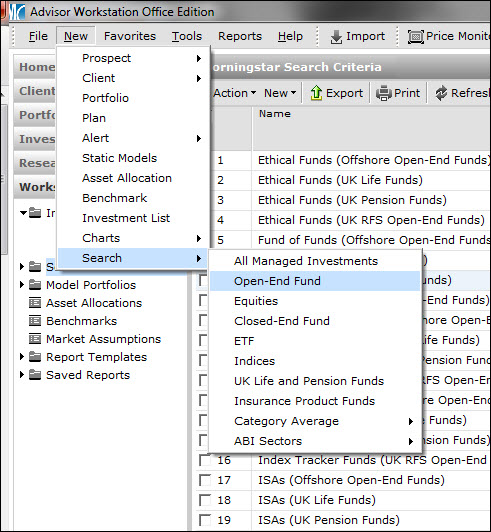
To find the funds in Adviser Workstation, run a search in the Open-End funds universe by going to New>Search>Open-End Fund.

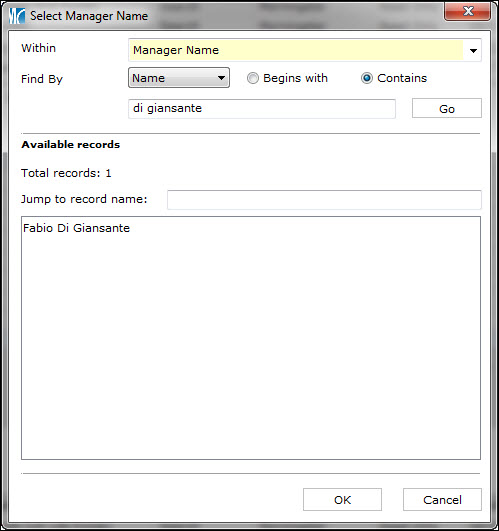
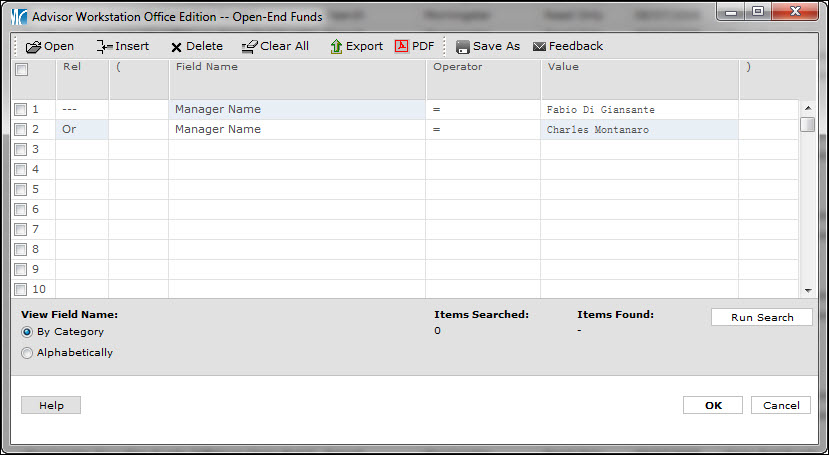
In the first row under Field Name, scroll to find Manager Name, then type in the name and click GO. Once you’ve found the manager, click OK to add the name to the search.

You can add multiple managers at once by using ‘OR’ in each row of the search.

Quick Tip: When typing the name in the Manager Name box, select ‘Contains’ instead of ‘Begins With’ to search first names and surnames.

Visit the post on Analyst ratings to see read more about the managers.

Posted in: Events, Morningstar, Press Releases, Quick Tips, Research,

Acronyms Galore: FSA’s RDR FAQs

by Caroline Gutman on 29 Feb 2012

The FSA recently published a list of FAQs from their roadshows on RDR. We’ve featured a few of them just below and have included helpful Adviser Workstation shortcuts.

**-If I consider a product, but I don’t feel comfortable recommending it due to its risky _nature, can I still call myself independent?

_**

__A firm should only hold itself out as giving independent advice if it is prepared to provide advice on all types of retail investment products that may be suitable for their clients. Such a firm may, however, after considering the market, take the view that certain retail investment products are unlikely to be suitable for their client base. If this is the case, then that firm would not need to carry out a comprehensive review of the market for these products for each of their clients. We would not expect firms when forming advice for a client to review the market for a product that would not be suitable, let alone to recommend such a product.

(Morningstar Quick Tip: Filter out any unsuitable products for your clients by building a custom filter in Adviser Workstation. See how to build a search by clicking here)


-If a firm has three advisers who give restricted advice, but as a team they can advise on all retail investment products, can the firm hold itself out as independent?

No one in a firm that holds itself out as independent should make a personal recommendation to  a retail client unless that personal recommendation is based on a comprehensive and fair analysis  of all types of retail investment products which may be suitable for that client.

(Morningstar Quick Tip: Use Morningstar Analyst Rating reports for independent, objective analysis on open-end funds, equities and investment trust funds. Click here to learn how to find the ratings)


-What is meant by relevant market in the context of independent advice?

_ **_A relevant market should comprise all retail investment products which are capable of meeting the investment needs and objectives of a retail client. To use the example of ethical products, for clients who only want these, it is clear that a range of products would never be suitable for them, namely non-ethical products. The relevant market for these clients would not include all retail investment products, but would include all ethical retail investment products. Relevant markets are defined by client needs, not by any other factor.

We expect it to be rare that an adviser could completely rule out advising on certain types of retail investment products on the basis that they will not be suitable for any of their clients, and to limit their advice to a particular relevant market. If they can identify a narrower relevant market, they should not hold themselves out as offering independent advice in a broader sense.

(Morningstar Quick Tip: Save a list of ethical and/or socially conscious funds to quickly add funds to a client’s portfolio. Click here to find out how)


Questions and responses taken from Financial Services Authority’s Finalised Guidance, February 2012. Click here to view the report and other FAQs

Posted in: IFA News and Commentary, Morningstar, Quick Tips, Research,

Global Income – A Perfect Partnership?

by Caroline Gutman on 09 Feb 2012

Live Wednesday, February 22, 1pm – 2pm or afterwards on demand

In the current economic climate of low interest rates and low or even negative returns, income funds are fast becoming the must-haves. In this free online webinar, a panel of global equity experts will be talking about where they’re seeing compelling opportunities for growing income; why it is that their investment trusts have been able to deliver steady, predictable income growth for their shareholders; and why global income isn’t just a passing phase.

Attend here: http://www.brighttalk.com/r/TkD

This session will be moderated by Jackie Beard, Director Closed-end Fund Research, Morningstar who will be leading the discussion alongside:

  • Bruce Stout, Senior Investment Manager, Aberdeen Asset Management
  • Peter Hewitt, Director, Global Equities at F&C Asset Management, F&C Investments
  • James de Sausmarez, Director and Head of Investment Trusts, Henderson
  • John Baker, Joint Fund Manager of J.P. Morgan Income and Capital Trust, J.P. Morgan Income and Growth Trust and J.P. Morgan Elect Managed Income

If you are unable to join any the live event, you can watch on demand immediately afterwards. During the live event you will be able to submit questions to the panel and take part in audience votes.

Posted in: Events, IFA News and Commentary, Morningstar, Research,

Quick Tip – Find Funds Outside the Eurozone

by Caroline Gutman on 31 Jan 2012

With Greece and Italy’s debt crisis on the front page of the news, investors are taking a greater interest in funds beyond the Eurozone. Here’s a quick search you can run to look for funds with investments primarily outside Europe:

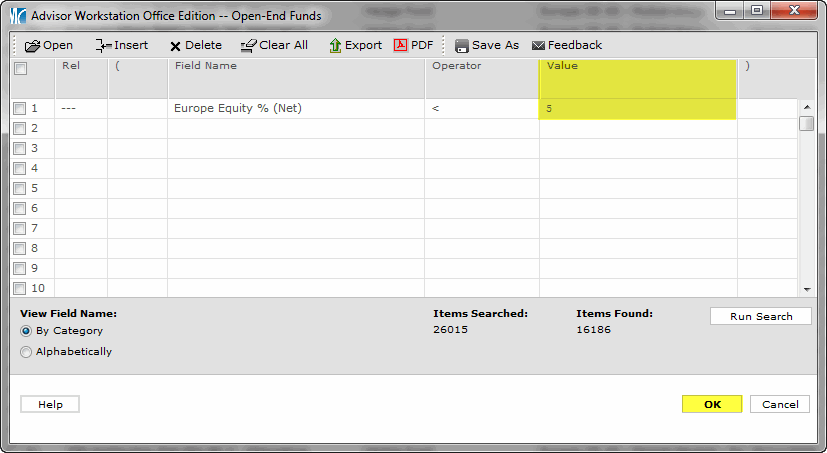
Go to Research>Open End Funds>United Kingdom RFS Open-End Funds, then select the Search button and enter the following:

In the Value Column, you can designate how much Europe Equity (%) you’ll allow:

As with other searches, you can add additional search criteria in the rows below. To save the search, click Save As and enter a name.

Posted in: Morningstar, Quick Tips, Research,

Quick Tip: Morningstar Analyst Ratings

by Caroline Gutman on 27 Jan 2012

In addition to Morningstar Star Ratings, Morningstar Analyst Ratings can add value to your investment proposition with objective, detailed fund analysis. Morningstar analysts assign a Morningstar Analyst Rating to funds using a five-point scale ranging from Gold to Negative. Analysts rate funds on a relative basis, against a pan-European and Asian universe of funds in a similar peer group. The ratings scale is unique from other firms because it includes negative ratings which allow analysts to assess and rate poor funds, as well as good funds.

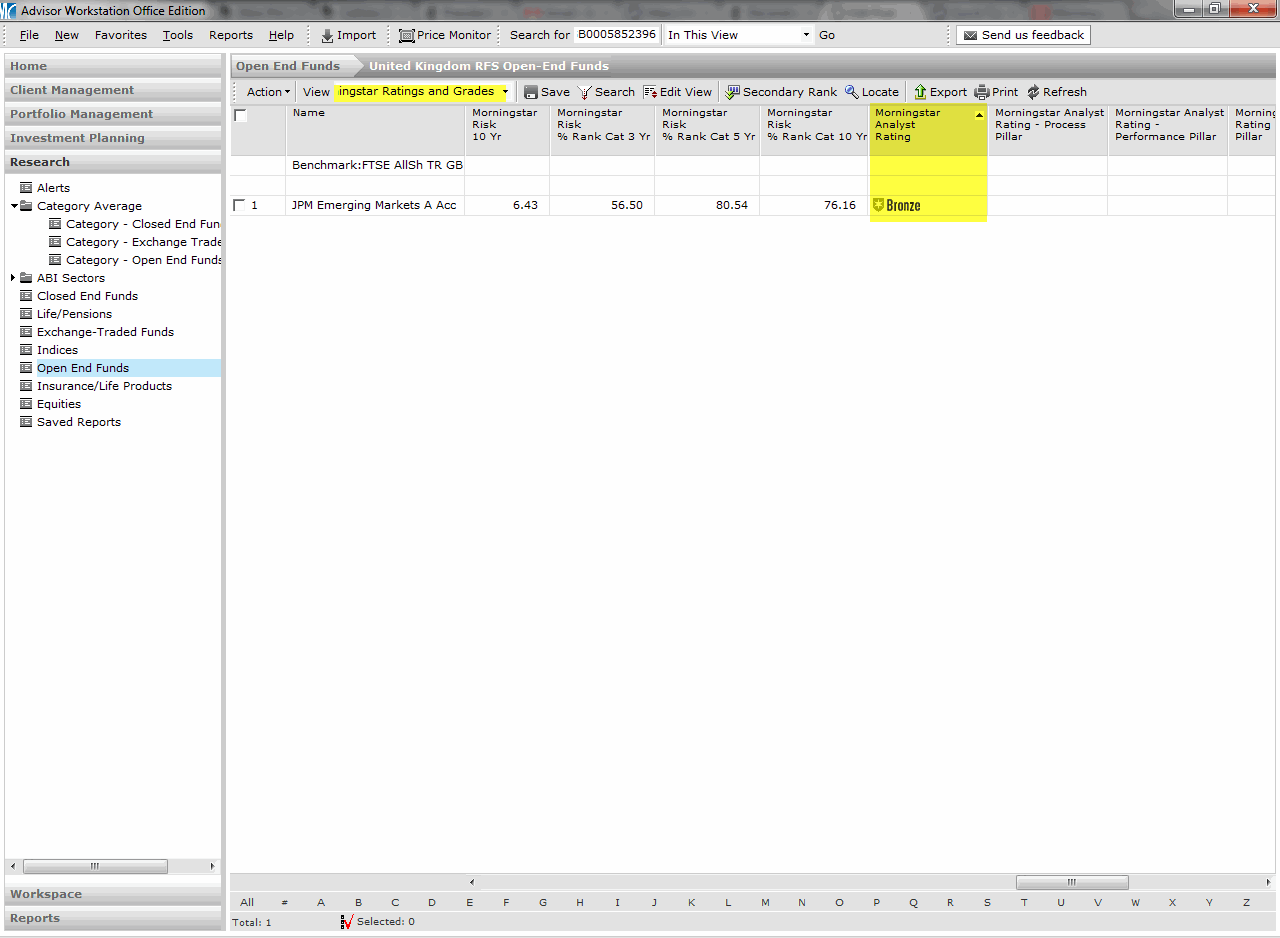
To see if a fund has received a Qualitative Rating, open the fund in an Investment List, Portfolio, Model Portfolio, or in the Research universe. Change the view to: Morningstar Ratings and Grades and scroll to the right to Morningstar Analyst Rating:

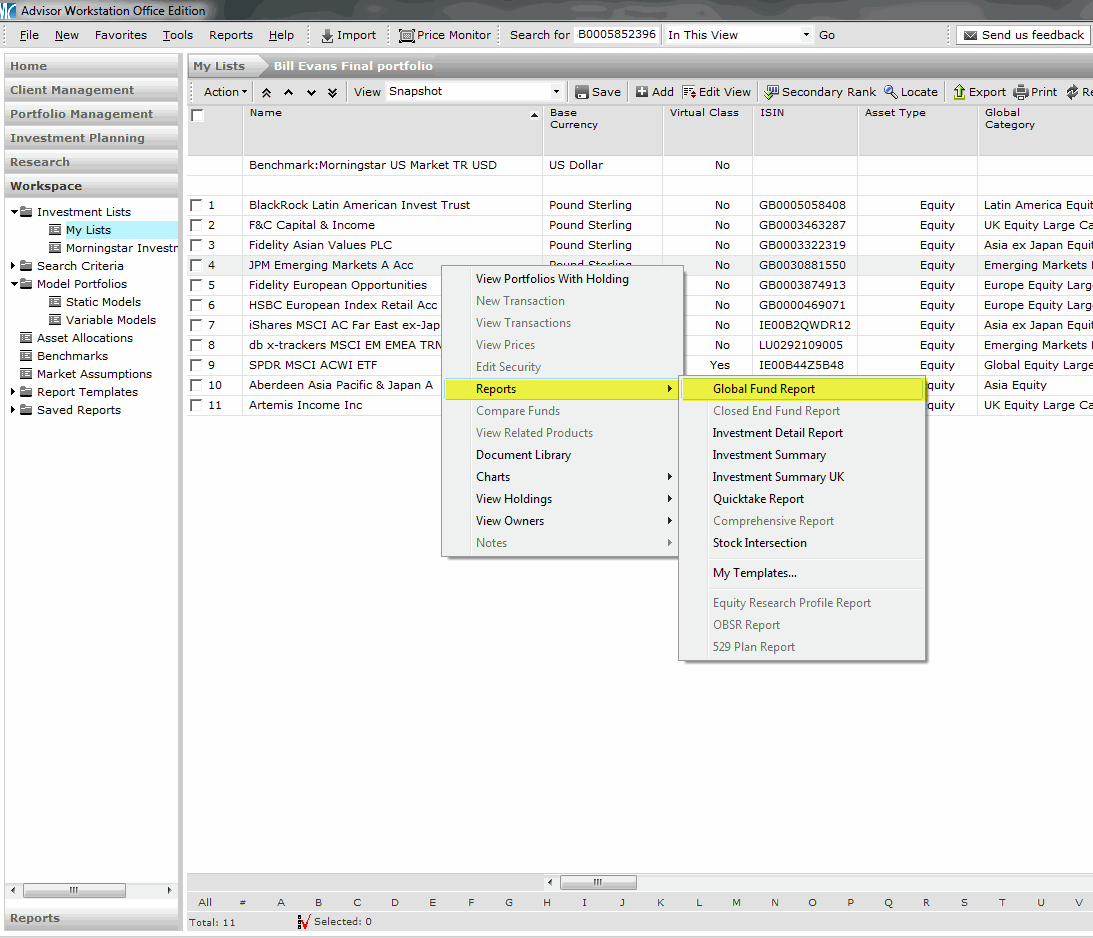
To view a rated fund’s Analyst Rating report, go to an Investment List, Portfolio, Model Portfolio or the Research unvierse:  Right click on the fund’s name and select Reports>Global Fund Report:

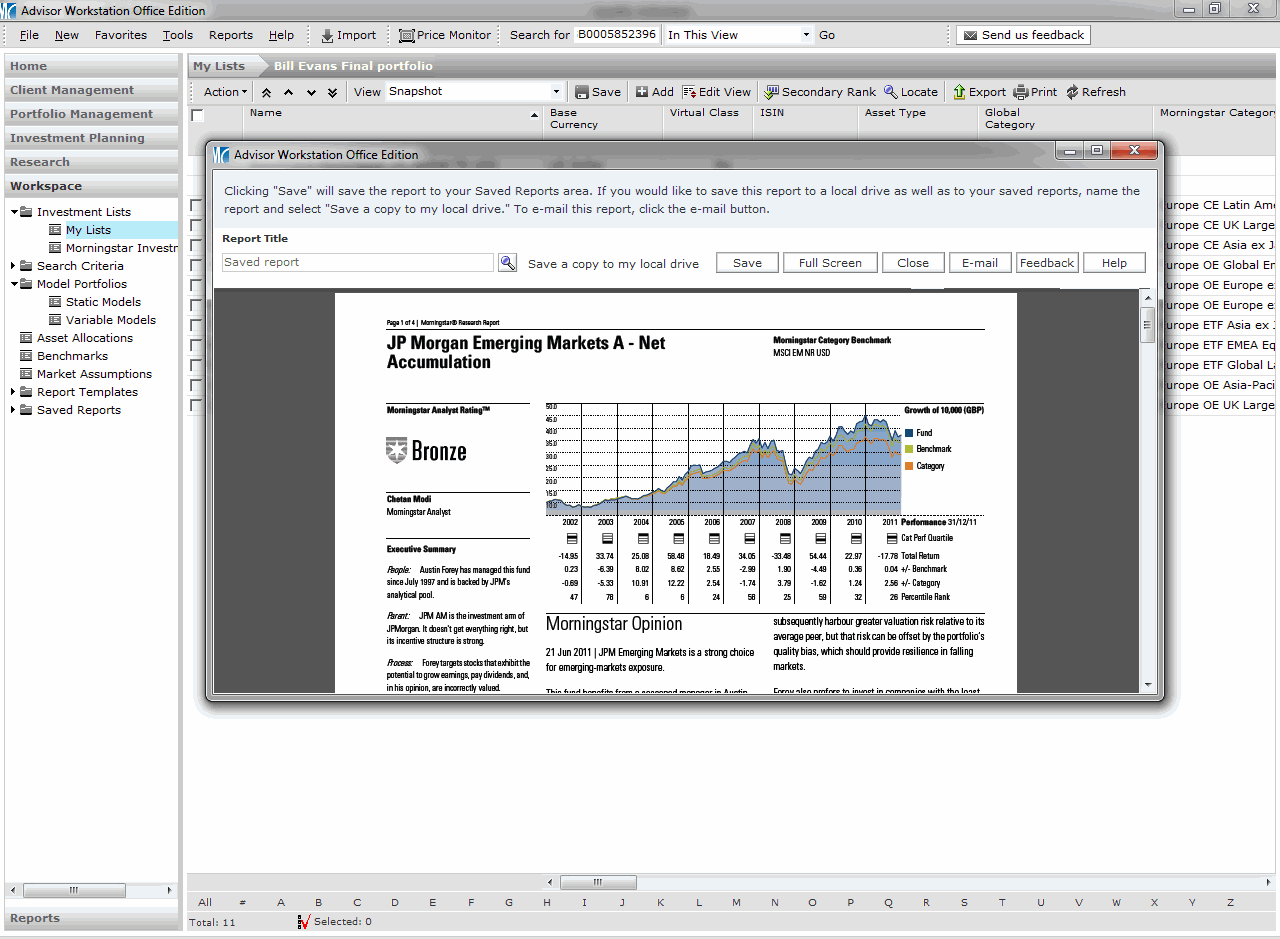
The report will open in a new window which you can save to your computer, post to a client’s Web-Portal, or print:

Read more about Morningstar Analyst Ratings by clicking here

Posted in: Morningstar, Quick Tips, Research,

Enhanced Morningstar Analyst Ratings for Funds

by Caroline Gutman on 23 Nov 2011

Morningstar launched its analyst-driven ratings for funds in Europe and Asia in February 2009. Since then, our team has published ratings and in-depth reports on 1,145 funds, published in eight languages. We seem to have struck a chord with you—collectively the reports have been downloaded more than 2 million times. But we think we can make our work even better. To do that, today we are launching a revised Morningstar Analyst Rating scale that will be used by our 90+ qualitative fund analysts around the world, and new, even more-in-depth reports to complement the ratings will arrive in early 2012.

**Out with the Old, in with the New
** The principle change is to the ratings scale we use to express our analysts’ opinions.

The new Morningstar Analyst Rating scale is as follows:

Positive Ratings:

  • Gold: Best-of-breed fund that distinguishes itself across the five pillars and has garnered the analysts’ highest level of conviction;
  • Silver: Fund with notable advantages across several, but perhaps not all, of the five pillars—strengths that give the analysts a high level of conviction;
  • Bronze: Fund with advantages that outweigh any disadvantages across the five pillars, and sufficient level of analyst conviction to warrant a positive rating;

Neutral: Fund that isn’t likely to deliver standout returns, but also isn’t likely to significantly underperform; and

Negative: Fund that has at least one flaw likely to significantly hamper future performance, and is considered an inferior offering to its peers.

Previously, we used a symmetric five-tier scale that included two positive ratings, a neutral rating, and two negative ratings (Elite, Superior, Standard, Inferior, and Impaired). The new scale bundles our negative views into a single rating and we now have three levels—Gold, Silver, and Bronze—to provide an additional level of detail in our positive ratings. This gives investors more granular insight into our views on the funds they are likeliest to own and allows us to more clearly signal to investors whether our conviction level on positively-rated funds is growing stronger or weaker.

Rest assured, however, that there is no change to our research approach: Our analysts continue to rate funds based on their conviction in a fund’s ability to outperform its benchmark or peers over the long term. To arrive at a rating, they evaluate five key pillars our experience has shown us are critical to a fund’s ability to succeed: People, Process, Parent, Performance, and Price. For more information on the methodology, click here. There is also no change to our business model: As before, we do not accept payment to rate funds, and the ratings decisions lie solely in the hands of our independent analysts.

**Coming Soon: Enhanced Reports
** When we launched our ratings in 2009, we believed it was essential to provide investors with an in-depth report to give them full transparency on the rationale for the ratings decision taken, and our views on each of the five pillars we evaluate. That report is still in place today, but in early 2012, we will replace it with a greatly enhanced, more in-depth format with even richer proprietary analytics and data to support our analysts’ work. Among these will be a summary scorecard for the five pillars, with each pillar graded as positive, negative, or neutral, to provide even greater transparency around the rationale for the rating.

The purpose of our research is to help you, our users, make better investment decisions and the new rating and reports have been designed with this goal kept constantly in mind. The new ratings are now available in our products, including this web site. As always, we value your feedback, so please let us know what you think in the comments section below.

By Christopher J. Traulsen

Posted in: Morningstar, Press Releases, Research,