Web-based research, planning, portfolio management and client reporting tool allows advisers to analyse a client’s attitude to risk and existing portfolios

Asset allocation is the foundation for building well-diversified portfolios. It offers a strategic approach to portfolio design by combining asset classes such as stocks, bonds and cash to meet an investor’s goals. For advisers – whether running your own asset allocation strategies or taking guidance from ready packaged asset models – it is of vital importance that the data powering your software solution is based on sound methodologies and a reliable set of expectations for returns, risk, and correlation.

Morningstar’s asset allocation tools draw heavily on the work of Ibbotson Associates, a unit of the Morningstar Investment Management division recognised worldwide for its academic research into asset allocation. Back in the early 1970s, in what would prove to be ground-breaking research, Ibbotson founder Roger G Ibbotson, along with Rex Sinquefield, researched and assembled the annual returns for several US asset classes dating back to 1926.

This seminal work allowed for the analysis of risk and return characteristics of different asset classes and today serves as a foundation for much of the modern asset allocation used in Morningstar’s software solutions for advisers.

Efficient frontier

Morningstar Adviser Workstation is a web-based research, planning, portfolio management and client-reporting platform. It provides access to Ibbotson asset allocation, capital market assumptions and asset models, and allows advisers to analyse a client’s attitude to risk and existing investment portfolios. The platform’s embedded risk-profiling and asset allocation tools are powered by models developed by Ibbotson Associates.

Inputs to asset allocation models typically include three types of assumptions about the behaviour of asset class returns: (1) the expected return of each asset class, (2) the volatility of the returns on each asset class, and (3) the correlation between the returns of each pair of asset classes. Diversification helps reduce portfolio risk; as the number of distinct asset classes in a portfolio increases, the total risk or volatility can be decreased up to a point without sacrificing expected return.

If risk cannot be further reduced without sacrificing expected return, the portfolio is said to be efficient. The set of all efficient portfolios is called the efficient frontier. In theory, investors should only choose among efficient frontiers.

The correlations among asset classes determine the degree to which risk can be reduced through diversification. The lower the correlations, the greater are the potential diversification benefits. Morningstar Adviser Workstation contains a tool known as a mean-variance optimiser that calculates the efficient frontier from the asset class assumptions. It can also impose various constraints on the portfolios selected, such as placing a maximum on equity exposure, to help ensure diversification or impose limits that the adviser and investor agree are needed.

Research has shown that expected return assumptions have great impact on the composition of efficient portfolios. Ibbotson Associates developed an approach to creating excepted return assumptions called the building-block approach. This combines current market data, such as bond yields, with historical performance relationships to build expected return assumptions that researchers at Ibbotson believe provide the best estimate of what market participants are expecting future long-term returns to be.

To assist your work in proposing the correct asset allocation mix based on your client’s risk profile, the Morningstar platform provides five strategic asset allocation guidance models that are aligned to the risk profiles generated by the embedded Morningstar risk tolerance questionnaire. Alternatively, the embedded methodology also allows advisers to create their own asset models based on Morningstar Investment Management’s capital market assumptions.

If choosing the latter, the asset allocation mix can be constructed through analysis of the various asset classes, their behaviours and how they blend.

The adviser is then able to match up investments to a proposed asset allocation to construct a portfolio. To build the portfolio will require the ability to understand the asset allocation breakdown of the investments being selected.

At Morningstar we insist on the collection of full holdings data from fund providers. Morningstar then classifies funds according to their asset breakdowns, enabling advisers to search for the funds that meet their needs with ease. This means that when you are looking at constructing a portfolio, you will do so based on comprehensive data that fits the asset models you are using.

All of the asset allocation tools described here are packaged into the investment advice process of Morningstar Adviser Workstation to enable advisers to run their clients through an investment process.

They can be combined with other research tools and data available through the platform, including Morningstar and OBSR’s forward-looking analyst ratings and research reports that provide in-depth analysis of approximately 700 funds available to investors in the UK.

###

By Anastasia Georgiou and Paul Malone
Read more: http://www.investmentweek.co.uk/investment-week/feature/2124253/morningstar-workstation-aid-asset-allocation-decision/page/2#ixzz1eLW4qQrq
Posted in: Morningstar, Research,

What is changing?

The Morningstar RatingTM for closed-end funds aims to measure a manager’s or team’s skill based on their performance. It is a backward-looking measure, calculated using the last 3-, 5-, and 10-years of performance. Until now, the rating calculation has used the fund’s closing market price, but starting in November 2011 the calculation will use the fund’s Net Asset Value (NAV) instead.

In addition, Morningstar will no longer calculate the Morningstar Rating for closed-end funds according to their Association of Investment Company (AIC) sectors. Instead, we will compare London-listed investment companies against their peers in the Morningstar Category system, which is available at (link).

Why is Morningstar making these changes?

We believe that using a fund’s NAV in its Morningstar RatingTM calculation is superior to closing market price as a measure of risk-adjusted performance given that listed funds are subject to influences outside the manager’s control, such as market sentiment. Moving to a NAV calculation therefore brings the closed-end fund rating methodology closer in line with the open-end fund rating methodology—which also uses NAV in its Rating calculation—allowing investors to more readily compare the performance of a selection of funds, irrespective of the funds’ legal structures.


Why are Morningstar’s Category definitions a more useful way to categorise funds?

For the purposes of calculating a Morningstar Rating, we believe Morningstar categories offer investors better granularity and peer group analysis because they are based on a fund’s holdings. Further, because they incorporate all mutual funds available for sale in the UK—both closed- and open-end funds— they result in a larger and more representative peer group for comparison. This is important in the calculation of the Morningstar Rating, which requires a peer group of a certain size for a Morningstar Rating to be viable. As a result of categorising closed-end funds in the Morningstar Category, we can now calculate ratings for more funds than before.

For example, JPMorgan Chinese Investment Trust sits in the Country Specialist Asia Pacific AIC sector. This sector comprises 14 listed funds investing in quite different areas geographically—for example, Vietnam, India, and Thailand—so a rating against this peer group is of limited value. When we compare this fund against its peers in the Morningstar Chinese Equity Category, which includes not just investment trusts, but open-end and exchange traded funds too, that comparison spans 227 fund share classes, all of which invest in Chinese equities. This makes it a far more meaningful comparison as a true like-for-like basis.

Which funds are affected by this change?

The Morningstar Ratings for all investment companies listed on the London Stock Exchange are affected by this methodology change.

How is gearing incorporated into the calculation?

The Morningstar Rating for closed-end funds is calculated with risk-adjusted performance, and as gearing tends to increase the volatility of a fund’s returns, it also increases risk. In our methodology, we penalise funds for taking risk, but reward them if they do it well and add value for investors. So if a manager uses gearing well, then although there will be a penalty for taking extra risk, there is also a reward for making it work. This means investors can still compare closed- and open-end funds on a like-for-like basis.

Are there any closed-end funds that are not eligible for a Morningstar Rating?

Yes. There are some Morningstar categories for which we don’t rate closed-end funds—for example, Property – Direct Europe, as these funds are investing in bricks and mortar and not equities. The Morningstar Category system, available at LINK, details which fund categories are not eligible for a Morningstar Rating.

How many closed-end funds now receive a Morningstar Rating?

254 (as at 31 October 2011)


Does the Morningstar Rating for closed-end funds take transaction costs into account?
No. Closed-end funds are shares listed on a stock exchange, so they are subject to brokerage fees. The amount of this fee varies by broker and by size of the trade. As a result, any such fee we might factor in would be arbitrary. Transaction fees are not therefore incorporated in the calculation of the Morningstar RatingTM for closed-end funds.

**Does the revised Morningstar Rating methodology for closed-end funds also apply to ETFs?
** No. As open-end funds, exchange-traded funds already receive a Morningstar Rating according to their Morningstar Category.

Posted in: Morningstar, Research,

Join Morningstar’s  Jackie Beard for a panel discussion on the challenges faced by an investment board at 1pm on 14 September 2011.  This is particularly  relevant in the current environment, with the ever-increasing burden upon non-executive directors as stewards of shareholder capital.  The session will also look at why their role gives the fund a distinct advantage over its open-end counterparts and the different ways in which they can add value for shareholders.

Jackie would like to make sure this session addresses any concerns that you, our advisers, have, and to answer the questions that you want answered. So we  invite you to post any questions on corporate governance of closed-end funds that you may have on the blog between now and 13 September.   The panel really is an outstanding line up with

Scott Dobbie CBE; Gill Nott OBE; Hugh Aldous; Peter Arthur and James Saunders Watson. It’s not often one gets the chance to question such an esteemed group of people, so don’t miss this opportunity. While it’s unfair to single out individual panel members, Ms Nott’s OBE was for services to financial education and Mr Dobbie’s CBE for services to financial regulation.

Register for the event by clicking here.

Posted in: Events, Morningstar, Research,

How Do Synthetic ETFs Work?

by jmurphy on 22 Jul 2011

Morningstar ETF analyst Hortense Bioy recently wrote an article for FTAdviser explaining some of the concerns over synthetically replicating ETFs and how these products aim to deliver returns to investors. Click here for the full article on FTAdviser.

Posted in: Research,

Morningstar Global Fund Ratings

by jmurphy on 30 Jun 2011

A sneak peak at the new Global Fund Research Report

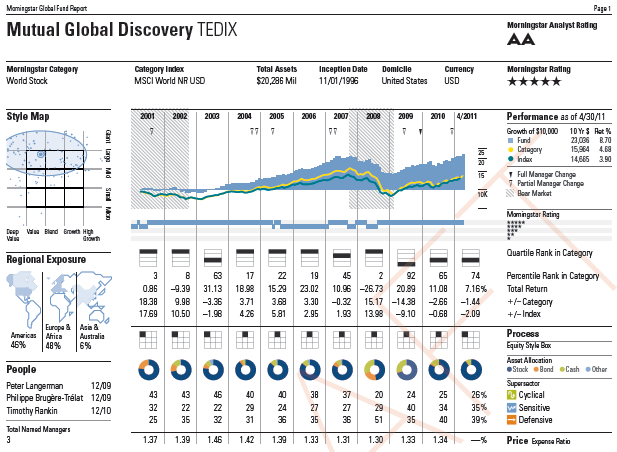
Since April of 2010, Morningstar and OBSR fund analysts have been harmonizing their processes and methodologies for rating funds and writing reports. The two ratings have been linked and users of Morningstar tools can take advantage of the increased ratings coverage and expanded expertise the larger analyst team provides. The culmination of this process will come later this year (Q4) when Morningstar will launch a unified global fund rating and analyst report.

The new rating and report will replace the existing Morningstar qualitative rating andthe  OBSR rating while combining a wealth of analysis and data in one report. These reports will be universal worldwide, allowing for wider coverage of funds and a consistent approach to fund analysis for investors.

The new rating scale will consist of 5 ratings: AAA, AA, A, Neutral, and Negative. AAA funds will be best of breed and will reflect the analysts’ highest level of conviction. A Neutral fund is one that is not likely to standout, either positively or negatively. And a Negative rated fund will be one that has at least one flaw that is likely to significantly hamper future performance. For a complete explanation of the new rating scale, please click here.

For more details and a sample of the global fund research report, please visit our press kit here.

Posted in: Press Releases, Research,

In the wake of the crisis hitting Japan this week, we take a look at the Japanese closed-end funds sector to see how the funds are responding.
</p>

There are just eight dedicated Japanese equity closed-end funds, of which six are biased towards smaller companies, an area of the market that’s been hit particularly hard in the last few days. Yesterday alone saw the TSE 1 Small fall more than 10%. Add to that the fact that all six smaller-companies funds are geared to some extent and it doesn’t sound like it will paint a pretty picture.

But a look at the CEFs’ discounts, as shown in Table 1 below, suggests the recent falls haven’t made them screamingly cheap. Only three funds are trading at discounts greater than their three-year average and all are well above their discount levels from six months ago.

That’s not the whole picture, though. We need to look at how their NAVs have been affected by the market turmoil. It’s no good just looking at the level of absolute discount; relative discounts matter. After all, there’s no guarantee the NAV will be less affected than the share price.

We can see in Table 2 below, though, that NAVs have held up marginally better than the share prices, albeit everything has headed south. What’s encouraging is that we’re not seeing panic-selling driving the share prices down at a rate faster than the Japanese market, adding further credence to our view above.

We should also look at gearing in the funds as this has an impact, too. The highest geared fund is Baillie Gifford Japan (BGFD) at 23% net gearing. Some way behind this is Baillie Gifford’s smaller companies fund, Shin Nippon (BGS), and JPMorgan Japan Smaller Companies (JPS) at 17%. While the two Baillie Gifford funds are long-standing fans of gearing, with it in place as a matter of course, the managers at JPS only brought gearing back into the fund in January this year, having taken it off in July 2010.

As yet, the gearing hasn’t had a significantly detrimental effect on these funds. However, it’s way too early to tell if this can last and the full impact of the quake and tsunami is far from clear yet.

What we do know is that these funds are weathering the storm as well as can be expected, for now, and there’s no reason for investors to panic-sell.

Posted in: Research,

The Search for Income

by jmurphy on 01 Feb 2011

In the past 6 months or so I’ve had several conversations with advisers in search of more research and analysis on income producing investments. Dividend rates, dividend consistency, annual yield, projected yield, the list goes on. More and more people are looking for income producing investments and ways of showing the effects of income on a portfolio. These needs have sparked a discussion at Morningstar about how we can help advisers find the best income producing investments and determine the effects of that income on a client’s financial situation. We currently collect distribution payment data for open end funds, investment trusts, ETFs and of course equities. This data is usually not very hard to come by. But there seems to be a need to interpret this data as income that a client has received or might receive should they invest in those investments or in a particular portfolio of investments.

Will the income be enough to cover living costs once a client retires? How reliable is the income stream from an investment? How has the income taken from a portfolio affected the performance of a portfolio of investments over time?

There is also a rapidly growing need for advisers to be able to find the best income producing investments for clients who are approaching retirement or who are already in their golden years. Income consistency, yield rate and underlying stock picks are all important factors when searching for income producers. We see a need for better data and better tools to help advisers identify good quality funds that can be the engines of production at the core of a retirement portfolio.

This discussion is still in it’s early days so if you have any requests or suggestions on what Morningstar can do to improve income analysis please let us know in the comments below.

Posted in: Research,

Investment trusts have gained a lot of popularity in the last year – partially thanks to the launch of Anthony Bolton’s Fidelity China Special Situations trust. If you’re looking for some plain-English explanations about investment trusts and how they might be used in client portfolios, join Morningstar analysts for this presentation. Click here for more details and to register.

Posted in: Events, Research,

ETF Focus

by jmurphy on 26 Nov 2010

We’ve had a flourish of Closed-end fund/investment trust posts of late so thought I would mix it up a bit with a look at what our European ETF analysts are talking about. The team, some based here in London, some back in Chicago, regularly write for Morningstar.co.uk. If you use ETFs or are considering their merits, check out the ETF tab of Morningstar.co.uk.

Below are links to two recent articles that discuss some very poignant issues facing UK advisers – foreign currency exposure in your clients’ portfolios and the never-ending search for yield.

No Need for Currency ETFs to Bet on Exchange Rates – John Gabriel, ETF Strategist

Desperately Seeking Yield – Jose Garcia-Zarate, European ETF Analyst

Posted in: Research,

Today is Thanksgiving Day in the US and, working for an American firm, it’s hard to ignore, even though it’s not a public holiday here in the UK.

The precise origins of Thanksgiving are unclear, but it’s a time to give thanks for a bountiful harvest. So how does this relate to closed-end funds, I hear you ask.

In a previous article we cited the resurgence of interest that closed-end funds have seen in recent months and at the end of October, net inflows stood at more than GBP 1.9 billion in 2010. This compares with a net inflow of just GBP 560 million for the whole of 2009.

What has prompted this interest? Many factors have helped but it is one man that has been the driving force: Anthony Bolton. The fact he and Fidelity chose to launch his new China Special Situations fund as a closed-end vehicle, and not an open-end fund, has been a huge boon to the closed-end fund world.

That’s not to say it has been a perfect fund launch. Bolton’s two-year commitment at the start was a deterrent to many investors, particularly institutional, as two years is a short time period. We’re firm advocates of long-term investing and in a market such as China it’s especially important to take a very long-term view.

Bolton himself said in a recent interview that there will come a time when all investors will own a China fund and be surprised there was a time when most people did not. But that’s not going to happen overnight.

Our concerns at his tenure have been mitigated somewhat this month as Bolton has confirmed his commitment at the helm to April 2013. This statement comes ahead of the public offer for subscription and placing scheduled for January. The company has also allotted more shares from its block listing and this facility hasn’t yet been exhausted.

The fund has been trading at a premium to its NAV since June 2010, and there’s no doubt in my mind that a good part of this is due to Bolton’s reputation and proven track record as an excellent investor. The recent share issue and confirmation of Bolton’s extended commitment have helped to reduce this.

So what’s the connection between Anthony Bolton and Thanksgiving? I’m thankful he chose the closed-end structure for his new fund as without doubt it has reinvigorated interest in these vehicles. This fund alone has helped to harvest some GBP 460 million into the sector upon its launch, with subsequent additional capital raised through further share issuance. CEFs have languished in the shadows of their peers for some years now, but as we highlighted in a series of articles recently, they have much to offer, including superior returns with lower fees.

Like their open-ended peers, though, they have their share of turkeys too.

Happy Thanksgiving!

Posted in: Research,