Thanks

by Caroline Gutman on 23 Dec 2011

From the Adviser Workstation team,

We’d like to thank all of our readers this year, and wish you a wonderful holiday and a happy New Year.

We’ll start off 2012 with a user forum in Southampton on January 18th at the Jury’s Inn. Details to follow, hope to see you there.

Register here for the User Forum

Posted in: Morningstar,

Adviser Workstation New Features

by Caroline Gutman on 15 Dec 2011

This weekend we’re rolling out a new release of Adviser Workstation. With it come a number of great new features including seamless importing, advanced charting, and customizable web portals.

Optional client overview

Webportal with customizable client overview

You can find the full list of new features below.

We’ll have training sessions over the next few weeks to introduce you to all the updates and help implement them into your practice:

Monday 19/12 at 10am

Tuesday 20/12 at 10am

Thursday 22/12 at 10am

Tuesday 3/1 at 2pm

Wednesday 4/1 at 10am

Friday 6/1 at 2pm

New Features

Positional History Tracking – we have enabled the ability to track changes over time within your model portfolios and client portfolios, without the need to track the full transactional history.

Flexible Portfolio Report – The snapshot report will have options for you to pick and choose which sections you want to include.  This is also enabled within batch reporting to allow for simpler reporting options

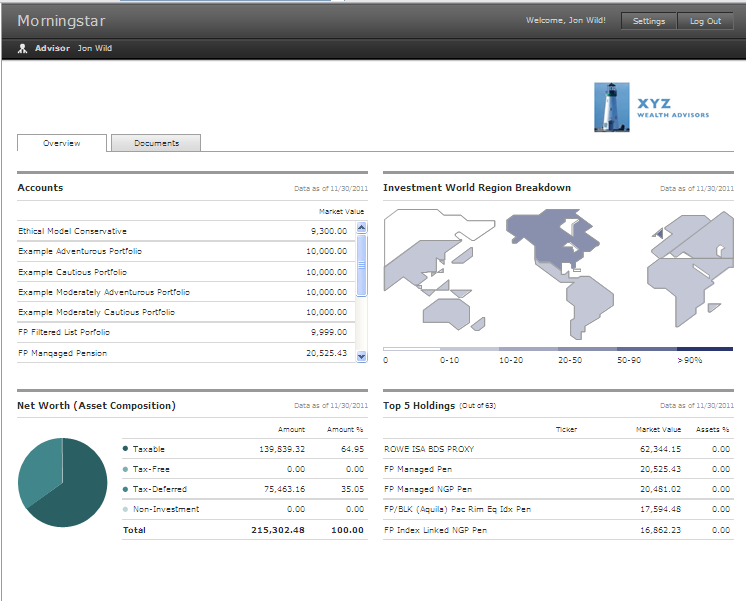
New, Improved Webportal – Now with an overview of investments screen including list of client portfolios with valuations, asset breakdowns and geographic breakdowns.  Client document upload feature, so clients have a way of providing signed documentation back to you with audit trail.

Quick access to Efficient Frontier – Under the main menu you will have quick access to the efficient frontier tool to allow you to quickly check your client’s portfolios risk and return.  There is also a flexible report option.

Transact seamless import – for advisers using the Transact platform, you can now bring in your data directly to adviser workstation.  You will need to have a data transfer agreement set up with Transact.

Income Charting – new charts that provide analysis on income

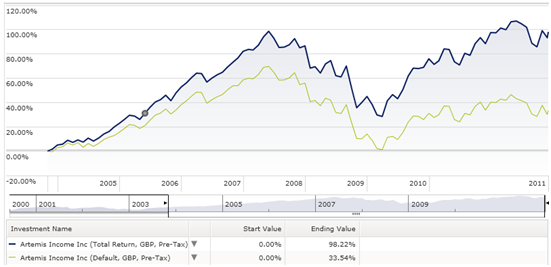
Income vs. No Income Chart: View the effect of reinvesting dividends on performance

Holdings Similarity Charts – charting tool that helps provide analysis on how similar the underlying holdings are to index tracked – this feature helps to highlight closet tracker funds.

If you would like to learn more about any of the above we are holding special traning sessions on the following dates, use the link to register:  https://www.formstack.com/forms/?1147562-V2J4VbuM3h

Posted in: Morningstar, Quick Tips,

Imperfect Hedges

by amcdonald on 13 Dec 2011

The Chicago Board Options Exchange Market Volatility Index (known as VIX) measures the implied volatility of S&P 500 index options – one way of measuring the expected 30-day stock market volatility.  This index has historically shown high daily correlations to the performance of the S&P and is therefore one of the tools used by managers seeking to hedge their equity exposure.


One interesting development in the second half of November was that the sharp (and brief) downturn in US equities had very little impact on the VIX.  This is unusual and caused problems for some fund managers, for example in the absolute return sector, who were using VIX options in a bid to moderate the downside volatility of underlying equity exposure.  As a result, we saw funds fall more sharply than they or investors would have expected over the very short period.  And while markets subsequently retraced, the speed and unexpected nature of the downturn at the portfolio level led some managers to cut their exposure for risk reasons and consequently fail to participate in the subsequent rally in equities.

This indicates the potential risk with hedging strategies and the benefit of diversifying portfolio-level hedges across different instruments to help ensure that a portfolio reacts as close to expectations as possible to adverse events, thus mitigating the risk of unexpected volatility stopping out high-conviction positions.  It is a truism that markets and associated instruments behave most unexpectedly, perhaps even irrationally, at the times of panic and therefore, by extension, that hedges cause surprises when they are most needed.  This is similarly important in fixed income markets, where credit default swaps (CDS) are often used to hedge underlying cash bond exposures; their behaviour can, however, diverge significantly at extremes due in part to the different investor bases of the two markets.

By Anthony McDonald

Posted in: Morningstar OBSR Commentary,

CancerIFA Profile

by Caroline Gutman on 09 Dec 2011

(Guest posting by CancerIFA)

Cancer is the most powerful word in the English language. Although medical science has dramatically improved recovery from most cancers, and terminal cancer has become largely an old person’s disease, people of all age groups nevertheless suffer from cancer, and everyone remains fearful of even the word ‘cancer’.

There is currently a range of anti cancer treatments, anti cancer drugs, diets and support services, and Cancer IFA is a new service principally for members of Employee Benefits Schemes who are terminally ill with cancer; Cancer IFA is therefore also a new support service for IFAs.

The story of Cancer IFA

The founder of Cancer IFA is George Emsden, a retired banker and financial adviser who four years ago had a sore throat that wouldn’t go away, that was ultimately diagnosed as throat cancer.

Cancer diagnosis is always a shock, but probably less so for George who at 19 years old saw his mother die of cancer, and a succession of friends and family thereafter. When George was diagnosed, he received lots of advice from doctors and charities on how to deal with friends and family, but no advice on having a big end of life experience. George loves Latin-American dancing, and he wanted a big end of life experience visiting Argentina, the home of the tango

To pay for his big end of life experience, he needed to know how much a two month, or three month tour of Argentina would cost, and how much his insurance policies pensions and other financial assets were worth. As a financial adviser, George already had the skills to value his financial assets, but most people don’t, and so the idea for a new business was born.

A service that helps cancer sufferers and also IFAs

Early diagnosis, a positive attitude, and the wonders of medical science have assured George has since recovered from cancer. And as he openly speaks about his cancer experience, many cancer sufferers and other people have described his story as an inspiration.

However, when relating his story to financial and pension advisers, George noticed they seemed uncomfortable advising clients recently diagnosed with terminal illness. Of course, George had no such discomfort, and above all felt a calling to help other cancer sufferers. So Cancer IFA was born as a service that assists the clients of financial and group pension advisers to find out how big an end of life experience they can have.

What is Cancer IFA and how does it work?

  1. Cancer IFA is a unique service for terminally ill cancer sufferers
  2. It helps sufferers to articulate, and ultimately to experience the dream of a last holiday or even to organise a final gift to the community
  3. The service is offered to sufferers and their spouses, who are members of a group pension or employee benefits scheme
  4. Cancer IFA provides the service by listening to the sufferer’s end of life dreams
  5. During two telephone meetings, the sufferers’ priorities and inspirations are carefully listened to, analysed and noted as options
  6. Cancer IFA then researches the cost of those options compared to the value of the sufferer’s assets, and recommends a ‘doable’ end of life dream experience

As a retired financial adviser, George Emsden is used to listening to people and comparing people’s dreams with their assets, and having experienced cancer, George is also able empathise with cancer sufferers

But Cancer IFA is neither a financial advice service, nor a holiday organiser! Rather, it is a pastoral service that researches ‘how big an end of life experience a cancer sufferer can have’, and therefore Cancer IFA, is quite different from the advice given by cancer charities and doctors

In summary, Cancer IFA is an inspiration

Cancer IFA is ‘open for business’ and every year will pay 5% of turnover to cancer charities. The Cancer IFA name is trademarked, and the service is offered direct to clients or through employee benefits schemes.

Cancer IFA is therefore a service offered via IFAs who lack the expertise to work with the terminally ill and want an expert to work with clients recently diagnosed with cancer

In summary, Cancer IFA is an inspiration for cancer sufferers who want a big end of life experience and need an empathetic and qualified professional to show how big an end of life experience they can have.

(Guest posting by CancerIFA)

For further information, contact:

C Morrison

Partner

Callum@cancerifa.com

07899 661 281

Posted in: Morningstar,

I recently went to a debate on the Eurozone crisis – one of many I suspect, but this was particularly interesting because it was excellently hosted by a leading political think-tank.  The speakers made illuminating points and the debate was lively, but in many ways I couldn’t help but feel a (growing?) gulf between the political and investment communities.  Of course, they operate in different areas for the benefit of different constituencies, but given the inextricable interdependence between political and economic outcomes, I was again surprised by the lack of common ground between the two.

Now this is far from a new phenomenon.  Back in 2010, the majority of investors to whom we have the privilege of speaking were convinced that the election would result in a solid Conservative majority that would be supportive for capital markets.  Now it is, of course, easy to be wise in hindsight but the electoral mathematics made this at best an uncertain outcome – a fact far more widely recognised in political circles.

Turning back to the Eurozone crisis debate led by influential political thought leaders and economists, we heard total opposition to bank recapitalisations and the view that at least Greece and Cyprus should leave the Euro.  These are not outrageous arguments, but they are at odds with the perhaps unrealistic expectations of the investment community that are increasingly necessary to avoid a full-scale meltdown in European debt markets.  Indeed, perhaps the expectations of the speed of change by the markets is completely unrealistic – they are looking for economic changes that would normally take years to implement.

However, at a time of general agreement that clear political leadership is necessary to address the crisis in a suitably comprehensive manner, it is a concern that there is an apparent gulf between political and economic expectations that appears not to be restricted only to the UK.  We have to hope that any such disconnect does not encourage bond market fears to spread to engulf current “safe” countries such as the UK and US, whose fiscal issues have hitherto paled against the Eurozone crisis.  And in the Eurozone, hopefully the appointment of technocrat governments in Italy and Greece will help address their problems although we will have to see if the local populations are willing to tolerate the application of painful austerity measures by new, unelected leaders, or if there will be some form of revolt.

By Anthony McDonald

Posted in: Morningstar OBSR Commentary,

Enhanced Morningstar Analyst Ratings for Funds

by Caroline Gutman on 23 Nov 2011

Morningstar launched its analyst-driven ratings for funds in Europe and Asia in February 2009. Since then, our team has published ratings and in-depth reports on 1,145 funds, published in eight languages. We seem to have struck a chord with you—collectively the reports have been downloaded more than 2 million times. But we think we can make our work even better. To do that, today we are launching a revised Morningstar Analyst Rating scale that will be used by our 90+ qualitative fund analysts around the world, and new, even more-in-depth reports to complement the ratings will arrive in early 2012.

**Out with the Old, in with the New
** The principle change is to the ratings scale we use to express our analysts’ opinions.

The new Morningstar Analyst Rating scale is as follows:

Positive Ratings:

  • Gold: Best-of-breed fund that distinguishes itself across the five pillars and has garnered the analysts’ highest level of conviction;
  • Silver: Fund with notable advantages across several, but perhaps not all, of the five pillars—strengths that give the analysts a high level of conviction;
  • Bronze: Fund with advantages that outweigh any disadvantages across the five pillars, and sufficient level of analyst conviction to warrant a positive rating;

Neutral: Fund that isn’t likely to deliver standout returns, but also isn’t likely to significantly underperform; and

Negative: Fund that has at least one flaw likely to significantly hamper future performance, and is considered an inferior offering to its peers.

Previously, we used a symmetric five-tier scale that included two positive ratings, a neutral rating, and two negative ratings (Elite, Superior, Standard, Inferior, and Impaired). The new scale bundles our negative views into a single rating and we now have three levels—Gold, Silver, and Bronze—to provide an additional level of detail in our positive ratings. This gives investors more granular insight into our views on the funds they are likeliest to own and allows us to more clearly signal to investors whether our conviction level on positively-rated funds is growing stronger or weaker.

Rest assured, however, that there is no change to our research approach: Our analysts continue to rate funds based on their conviction in a fund’s ability to outperform its benchmark or peers over the long term. To arrive at a rating, they evaluate five key pillars our experience has shown us are critical to a fund’s ability to succeed: People, Process, Parent, Performance, and Price. For more information on the methodology, click here. There is also no change to our business model: As before, we do not accept payment to rate funds, and the ratings decisions lie solely in the hands of our independent analysts.

**Coming Soon: Enhanced Reports
** When we launched our ratings in 2009, we believed it was essential to provide investors with an in-depth report to give them full transparency on the rationale for the ratings decision taken, and our views on each of the five pillars we evaluate. That report is still in place today, but in early 2012, we will replace it with a greatly enhanced, more in-depth format with even richer proprietary analytics and data to support our analysts’ work. Among these will be a summary scorecard for the five pillars, with each pillar graded as positive, negative, or neutral, to provide even greater transparency around the rationale for the rating.

The purpose of our research is to help you, our users, make better investment decisions and the new rating and reports have been designed with this goal kept constantly in mind. The new ratings are now available in our products, including this web site. As always, we value your feedback, so please let us know what you think in the comments section below.

By Christopher J. Traulsen

Posted in: Morningstar, Press Releases, Research,

Web-based research, planning, portfolio management and client reporting tool allows advisers to analyse a client’s attitude to risk and existing portfolios

Asset allocation is the foundation for building well-diversified portfolios. It offers a strategic approach to portfolio design by combining asset classes such as stocks, bonds and cash to meet an investor’s goals. For advisers – whether running your own asset allocation strategies or taking guidance from ready packaged asset models – it is of vital importance that the data powering your software solution is based on sound methodologies and a reliable set of expectations for returns, risk, and correlation.

Morningstar’s asset allocation tools draw heavily on the work of Ibbotson Associates, a unit of the Morningstar Investment Management division recognised worldwide for its academic research into asset allocation. Back in the early 1970s, in what would prove to be ground-breaking research, Ibbotson founder Roger G Ibbotson, along with Rex Sinquefield, researched and assembled the annual returns for several US asset classes dating back to 1926.

This seminal work allowed for the analysis of risk and return characteristics of different asset classes and today serves as a foundation for much of the modern asset allocation used in Morningstar’s software solutions for advisers.

Efficient frontier

Morningstar Adviser Workstation is a web-based research, planning, portfolio management and client-reporting platform. It provides access to Ibbotson asset allocation, capital market assumptions and asset models, and allows advisers to analyse a client’s attitude to risk and existing investment portfolios. The platform’s embedded risk-profiling and asset allocation tools are powered by models developed by Ibbotson Associates.

Inputs to asset allocation models typically include three types of assumptions about the behaviour of asset class returns: (1) the expected return of each asset class, (2) the volatility of the returns on each asset class, and (3) the correlation between the returns of each pair of asset classes. Diversification helps reduce portfolio risk; as the number of distinct asset classes in a portfolio increases, the total risk or volatility can be decreased up to a point without sacrificing expected return.

If risk cannot be further reduced without sacrificing expected return, the portfolio is said to be efficient. The set of all efficient portfolios is called the efficient frontier. In theory, investors should only choose among efficient frontiers.

The correlations among asset classes determine the degree to which risk can be reduced through diversification. The lower the correlations, the greater are the potential diversification benefits. Morningstar Adviser Workstation contains a tool known as a mean-variance optimiser that calculates the efficient frontier from the asset class assumptions. It can also impose various constraints on the portfolios selected, such as placing a maximum on equity exposure, to help ensure diversification or impose limits that the adviser and investor agree are needed.

Research has shown that expected return assumptions have great impact on the composition of efficient portfolios. Ibbotson Associates developed an approach to creating excepted return assumptions called the building-block approach. This combines current market data, such as bond yields, with historical performance relationships to build expected return assumptions that researchers at Ibbotson believe provide the best estimate of what market participants are expecting future long-term returns to be.

To assist your work in proposing the correct asset allocation mix based on your client’s risk profile, the Morningstar platform provides five strategic asset allocation guidance models that are aligned to the risk profiles generated by the embedded Morningstar risk tolerance questionnaire. Alternatively, the embedded methodology also allows advisers to create their own asset models based on Morningstar Investment Management’s capital market assumptions.

If choosing the latter, the asset allocation mix can be constructed through analysis of the various asset classes, their behaviours and how they blend.

The adviser is then able to match up investments to a proposed asset allocation to construct a portfolio. To build the portfolio will require the ability to understand the asset allocation breakdown of the investments being selected.

At Morningstar we insist on the collection of full holdings data from fund providers. Morningstar then classifies funds according to their asset breakdowns, enabling advisers to search for the funds that meet their needs with ease. This means that when you are looking at constructing a portfolio, you will do so based on comprehensive data that fits the asset models you are using.

All of the asset allocation tools described here are packaged into the investment advice process of Morningstar Adviser Workstation to enable advisers to run their clients through an investment process.

They can be combined with other research tools and data available through the platform, including Morningstar and OBSR’s forward-looking analyst ratings and research reports that provide in-depth analysis of approximately 700 funds available to investors in the UK.

###

By Anastasia Georgiou and Paul Malone
Read more: http://www.investmentweek.co.uk/investment-week/feature/2124253/morningstar-workstation-aid-asset-allocation-decision/page/2#ixzz1eLW4qQrq

Posted in: Morningstar, Research,

What is changing?

The Morningstar RatingTM for closed-end funds aims to measure a manager’s or team’s skill based on their performance. It is a backward-looking measure, calculated using the last 3-, 5-, and 10-years of performance. Until now, the rating calculation has used the fund’s closing market price, but starting in November 2011 the calculation will use the fund’s Net Asset Value (NAV) instead.

In addition, Morningstar will no longer calculate the Morningstar Rating for closed-end funds according to their Association of Investment Company (AIC) sectors. Instead, we will compare London-listed investment companies against their peers in the Morningstar Category system, which is available at (link).

Why is Morningstar making these changes?

We believe that using a fund’s NAV in its Morningstar RatingTM calculation is superior to closing market price as a measure of risk-adjusted performance given that listed funds are subject to influences outside the manager’s control, such as market sentiment. Moving to a NAV calculation therefore brings the closed-end fund rating methodology closer in line with the open-end fund rating methodology—which also uses NAV in its Rating calculation—allowing investors to more readily compare the performance of a selection of funds, irrespective of the funds’ legal structures.


Why are Morningstar’s Category definitions a more useful way to categorise funds?

For the purposes of calculating a Morningstar Rating, we believe Morningstar categories offer investors better granularity and peer group analysis because they are based on a fund’s holdings. Further, because they incorporate all mutual funds available for sale in the UK—both closed- and open-end funds— they result in a larger and more representative peer group for comparison. This is important in the calculation of the Morningstar Rating, which requires a peer group of a certain size for a Morningstar Rating to be viable. As a result of categorising closed-end funds in the Morningstar Category, we can now calculate ratings for more funds than before.

For example, JPMorgan Chinese Investment Trust sits in the Country Specialist Asia Pacific AIC sector. This sector comprises 14 listed funds investing in quite different areas geographically—for example, Vietnam, India, and Thailand—so a rating against this peer group is of limited value. When we compare this fund against its peers in the Morningstar Chinese Equity Category, which includes not just investment trusts, but open-end and exchange traded funds too, that comparison spans 227 fund share classes, all of which invest in Chinese equities. This makes it a far more meaningful comparison as a true like-for-like basis.

Which funds are affected by this change?

The Morningstar Ratings for all investment companies listed on the London Stock Exchange are affected by this methodology change.

How is gearing incorporated into the calculation?

The Morningstar Rating for closed-end funds is calculated with risk-adjusted performance, and as gearing tends to increase the volatility of a fund’s returns, it also increases risk. In our methodology, we penalise funds for taking risk, but reward them if they do it well and add value for investors. So if a manager uses gearing well, then although there will be a penalty for taking extra risk, there is also a reward for making it work. This means investors can still compare closed- and open-end funds on a like-for-like basis.

Are there any closed-end funds that are not eligible for a Morningstar Rating?

Yes. There are some Morningstar categories for which we don’t rate closed-end funds—for example, Property – Direct Europe, as these funds are investing in bricks and mortar and not equities. The Morningstar Category system, available at LINK, details which fund categories are not eligible for a Morningstar Rating.

How many closed-end funds now receive a Morningstar Rating?

254 (as at 31 October 2011)


Does the Morningstar Rating for closed-end funds take transaction costs into account?
No. Closed-end funds are shares listed on a stock exchange, so they are subject to brokerage fees. The amount of this fee varies by broker and by size of the trade. As a result, any such fee we might factor in would be arbitrary. Transaction fees are not therefore incorporated in the calculation of the Morningstar RatingTM for closed-end funds.

**Does the revised Morningstar Rating methodology for closed-end funds also apply to ETFs?
** No. As open-end funds, exchange-traded funds already receive a Morningstar Rating according to their Morningstar Category.

Posted in: Morningstar, Research,

Getting Ready for RDR

by Caroline Gutman on 11 Nov 2011

According to the RDR, independent advice must include all retail investment products which are capable of meeting the investment needs and objectives of a retail client. In this interactive panel session chaired by Jackie Beard of Morningstar, experts will discuss the challenges we all face in achieving this, as investors, advisers and product providers.

Getting Reading for RDR: http://www.brighttalk.com/r/c7P

__

Dial-in: 0203 051 2315 ext. 5042

Live Wednesday 16th November 1pm GMT, or watch afterwards on demand

Job Curtis, Manager of City of London Investment Trust, will share his thoughts as manager of a retail fund, joined by Patrick Mill, Sales & Distribution Director at Alliance Trust, Mark Atherton from The Daily Telegraph brings the consumers’ perspective; Piers Currie is the voice of the asset manager and Andrew Neligan, Informed Choice, that of the adviser. Join us for what is sure to be a lively debate on the challenges ahead as we move towards RDR D-Day.

Join the live webcast to interact with the expert panelists, submit your questions directly to the panelists and share your opinion through engaging audience votes: http://www.brighttalk.com/r/c7P

Registration for this event is free, if you cannot join live or you can register now to watch afterwards on demand.

Posted in: Events, IFA News and Commentary,
Anecdotes from the floor

by jbeard on 03 Oct 2011

Last year Peter Hargreaves famously accused the investment trust world of being fuddy-duddies. Last week, at the Investment Week IT Forum, there wasn’t a fuddy-duddy in sight. In fact, it was quite the opposite.

It’s not uncommon to attend such events and see the same faces, particularly at an investment trust forum. So this year I was encouraged to see some new faces – and firms – on the delegate front.

Those that came along weren’t disappointed; it was a day well spent. The Rt Hon Peter Lilley gave the keynote speech to kick the day off. Not only was he the Deputy Leader of the Opposition, he’s an MP who served on the board of JPMorgan Claverhouse for 11 years and Melchior Japan for more than four years. So the world of investment trust investing is something he understands very well.

That said, Lilley’s speech focused on the current Eurozone crisis; his most memorable comments, to me, were on the interaction of economics and politics. He said that he’s never known a period when politics are powering economics and interacting as much as they are currently and that, while economics usually triumph over politics in the long run, this outcome was far from certain right now.

For Keynesian fans, he also made the observation that Keynes wrote in a time when there was no sovereign debt crisis and no single European currency.

Lilley wasn’t the only good speaker of the day. Job Curtis, manager of City of London, reminded us of the benefits of an income discipline, both from his perspective as a fund manager but also from a company’s perspective to its shareholders. He cited the fact that dividends have historically grown above the rate of inflation in the major markets, so with interest rates set to stay low for some time, dividends really make a difference to total returns. And of course the closed-end fund structure helps, with the ability to retain income in the reserve account.

Geoff Hsu, portfolio manager of The Biotech Growth Trust and employee of OrbiMed, gave a comparison of the biotech industry now with nearly 20 years ago. Hsu’s presentation reminded me of the ultra-long-term mindset needed when investing in such small companies and of course how sensitive they are to politics and factors beyond their control.

The third session was Tom Slater, deputy manager of Scottish Mortgage Investment Trust. Did you know that a child born in Shanghai today has a higher life expectancy than a child born in Washington? I didn’t, until this session. And yet often China is still referred to as a developing country.

Next up was Tom Walker from Martin Currie. Many know Tom for his North American OEIC, but he also manages MC Global Portfolio Trust. He highlighted the importance of countries such as Indonesia, the fourth most populous country with 240 million inhabitants, and cautioned us not to focus purely on China for growth in the East. His colleague, Alan Porter, who manages Securities Trust of Scotland, pointed out that we don’t need to hold emerging-market stocks to have EM exposure. The top 15 brands of Heinz account for 70% of its sales, according to Porter, and 23% of its sales are in EM countries. Even more attention-grabbing is the fact they sell around 650 million bottles of ketchup a year. That’s a lot of sauce.

Vincent Devlin of BlackRock  tried to demonstrate the breadth of BlackRock Greater Europe’s wide remit to us, coupled with its decent yield, of 3.5% – not to be sniffed at in the current environment, especially for a European fund. Unluckily for Devlin, all we really wanted to talk about was Greece.

The views of Polar Capital’s Ben Rogoff were consistent with his presentation at our Morningstar Conference earlier this year. He continues to extol the virtues of cloud computing and, given all we’ve witnessed in markets in recent months, sees no reason why technology should be considered a higher-risk sector than any other. He believes Apple is the Tiffany of computing. I don’t think we’ll be seeing Steve Jobs covered in diamonds any time soon, though.

A session from Renaissance delved into Russian politics and the government’s recognition at last that it must invest in infrastructure; hence they launched a dedicated sector fund in July. Manager Takouhi Tchertchian was over from Moscow to explain her investment rationale in person, along with her insights into the Kremlin. Some of the stats were quite shocking: for example, only 48% of landing strips at Russia’s airports have lights and less than 60% are paved. That certainly puts the third runway debate in the south of England into perspective.

Last but not least, we heard from Alex Barr of Aberdeen, on why private equity shouldn’t be overlooked and the abundance of possibilities that are showing on his radar as a result of the volatility in equity markets.

This is just a snapshot of the day. It was a packed schedule with some excellent speakers. It’s good to see new faces at such events. I hope that next time even more advisers will be interested. Russian infrastructure may not be top of your shopping list but I certainly ended the day more knowledgeable than at the start.

Posted in: Events, IFA News and Commentary,