The Most and Least Loved Sectors

by Caroline Gutman on 30 Mar 2012

Technology is the most popular investment sector right now, according to the latest global survey of professional money managers by BofA Merrill Lynch.

Hot on the heels of Apple (AAPL) announcing it would begin paying a dividend for the first time since 1995, the monthly BofA Merrill Lynch Global Research report reveals that fund managers around the world are piling into tech stocks. Specifically in the US, Europe and the UK, technology is the most popular sector.

“A net 33% of eurozone investors are overweight technology, up from a net 10% in February. The sector has overtaken automotives/parts to become the region’s most popular,” says the report.

But with all the attention and money flowing into technology, is the sector as a whole becoming too frothy? Gary Baker, head of European equity strategy at BofA Merrill Lynch Global Research says he does not have a strong view about whether tech is overbought. However, he notes that as Apple continues grabbing headlines, the world’s largest company by market capitalisation is driving public attention towards the technology sector as a whole.

While investing in Apple can be tempting, especially now that it’s offering a dividend, Morningstar analyst Michael Holt values the company slightly below the current market value, indicating that now is not necessarily an ideal time to buy.

In his latest research report, Holt writes: “We view this [dividend and share buyback] move as a positive for Apple, but our fair value estimate does not change as this simply represents a partial distribution of the $98 billion in cash and investments that we were already accounting for in our fair value estimate. This move is a positive, however, because it lowers the risk that Apple will pursue aggressive acquisitions or other riskier uses of cash.”

Currently, other UK-based technology companies that are gaining attention for capitalising on the booming smartphone and tablet market are ARM Holdings (ARM) and Imagination Technologies (IMG). However, Morningstar analysts believe these companies are currently trading above their fair market value.

On the other end of the spectrum, the least loved sector globally is the utilities sector, according to the latest fund manager survey. Banks, insurance and telecoms are also remarkably unpopular.

Specifically within the UK, the report shows a wide range of sectors have fallen out of favour, including construction, real estate, retail, utilities, financial services and telecoms.

Utilities are widely considered to have a broken business model so people are avoiding this sector, says Baker. Dividend cuts amongst utilities companies have also contributed to the sector falling out of favour with professional money managers, he says.

Yet even though utilities and telecoms are now widely shunned by money managers around the world, pharma companies have become rather popular, according to the survey. Pharma is the third most popular investment sector after technology and energy, according to the report.

It may seem odd that pharma has become so hot while utilities and telecom have been avoided, since all three sectors are generally considered to be defensive, safe options for investors during tough times. But right now, pharma is seen as the most desireable option since it still offers decent yields, says Baker. Investments in the sector have come despite the difficulties pharma companies are facing with expiring drug patents, he says.

The money manager survey by BofA Merrill Lynch compiled responses from 278 institutional investors who manage nearly $800 billion in combined assets. The survey was conducted between March 9 to 15, 2012.

By Alanna Petroff
Posted in: Morningstar,

Click here for the full agenda, or visit our website to register and for more information. Any questions, please contact Natalie Shattock at investmentconference@morningstar.com.

Posted in: Events, Morningstar,

Debunking Post-Financial Crisis Myths

by Caroline Gutman on 20 Mar 2012

Dr. Paul Kaplan, Morningstar’s European Quantitave Research Director, will be presenting  Asset Allocation in the 21st Century at our Belfast User Forum, April 19th @ the Fitzwilliam Hotel. Click here to see the schedule and click here to register.

In the meantime, here are some post-Financial Crisis myths debunked by Dr. Kaplan:

1. The global financial crisis was a black swan
This is perhaps the biggest myth about the crisis. By definition, a black swan is an unprecedented major catastrophic event. However, there were many previous such crises whose long history motivated the late Hyman Minsky—writing in the mid 1980s—to formulate his “market instability” hypothesis to explain past crises and predict this one. Indeed, UK investors need only to recall the early 1970s to remember a time of even worse markets when equity investors lost 74% over a two-and-a-half-year period and took over nine years to recover.

2. Diversification did not work during the crash
This myth is due to an exclusive focus on equities. While it’s true that equities lost value worldwide during the crash, the same is simply not true across the asset classes. In fact, during the crash, investors fled to safety and in so doing drove up the price of high quality sovereign bonds (especially US Treasuries) causing asset class diversification to work when it was needed most. So while US stocks lost 47% of their value for the year 2008, a portfolio of 50% US stocks, 40% bonds, and 10% cash would have lost a mere 16% of its value.

3. Modern portfolio theory is dead
The essence of Modern Portfolio Theory (MPT) is that investors should hold diversified portfolios such that reward cannot be increased without an increase in risk and visa versa. The limitations of MPT—as first formulated by Harry Markowitz in 1952— lay not in its principles but in the maths that he used. The maths simply could not handle the sort of extreme events that occurred during the crisis. Now, in confusing the maths with the principles, some have declared MPT dead. Nothing could be further from the truth. Now in 2012, we have powerful enough mathematics and computers to apply the principles of MPT in light of the types of extreme outcomes that markets produce from time-to-time with the advantage of far more robust models.

4. Asset allocation should be used to balance the sources of risk
Noting that portfolios created according to the principles of MPT lead to portfolios in which equity exposure is the primary source of risk, some asset managers are today switching to a “risk parity” approach to asset allocation. In this approach, an asset mix is chosen to achieve a portfolio where all asset classes contribute equally to the overall risk; this, they point out, is not the same thing as allocating the portfolio equally among the asset classes. Since this leads to a low risk/low return portfolio, the entire portfolio is then highly levered to goose up the expected return. (Why anyone thinks this is a good idea in a post-crash world is beyond me.) What the risk parity approach is missing is the fact that the sources of risk are also the sources of return. Since equities remain the main source of long-term growth, it follows that equities should be the main source of risk!

5. Fundamentally weighted indexes are better than market-cap weighted indexes
Since equities are the main source of growth for long-term investors, it is no surprise that someone will claim to have found a better way to invest in them. One such claim is that if we weigh stocks by “fundamentals” such as earnings, dividends, revenues, etc, rather than by market capitalisation, we can create better index funds. However, it turns out that this approach is nothing more than placing a value tilt on a portfolio. Since value titled portfolios over the long run tend to outperform the market, so do these fundamentally weighted index funds. The downside is that these products also do poorly when value investing in general does poorly.

This Morningstar article first appeared in City AM.

Posted in: Events, Morningstar, Research,

And the Nominees Are…

by Caroline Gutman on 13 Mar 2012

Nominees for Morningstar European Fund Manager of the Year Awards 2012 have been announced, and Adviser Workstation can give you a closer look at the managers, their funds and our Morningstar Analyst Ratings.

The Morningstar European Fund Manager of the Year Awards draw from the expertise of Morningstar’s European fund analyst team and recognise a select number of fund managers in Europe who have demonstrated excellence in the past year and in their stewardship of fund shareholder capital over the long term. The awards are presented in two distinct categories: Fund Manager of the Year: European Equity and Fund Manager of the Year: Global Equity.

The nominees for the Morningstar European Fund Manager of the Year Awards 2012 are:

European Equity:
Fabio Di Giansante, Pioneer Funds Euroland Equity
Charles Montanaro, Montanaro European Smaller Companies
Laurent Dobler and Arnaud Cosserat, Renaissance Europe

Global Equity:
J. Kristoffer, C. Stensrud, Knut Harald Nilsson, Cathrine Gether, and Ross Porter, SKAGEN Kon-Tiki
Andrew Headley and Charles Richardson, Veritas Global Equity Income and Veritas Global Focus
Rajiv Jain, Vontobel Global Value Equity and Vontobel Emerging Markets Equity

Nominations for the awards are made by Morningstar’s European fund research team of 30 analysts located in the United Kingdom, France, Germany, Italy, Spain, The Netherlands, Finland, and Norway. To qualify for a nomination, at least one fund under a fund manager’s leadership must have a qualitative fund rating assigned from Morningstar.

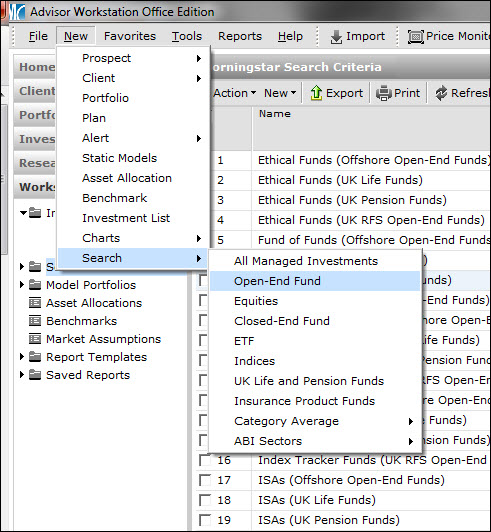
To find the funds in Adviser Workstation, run a search in the Open-End funds universe by going to New>Search>Open-End Fund.

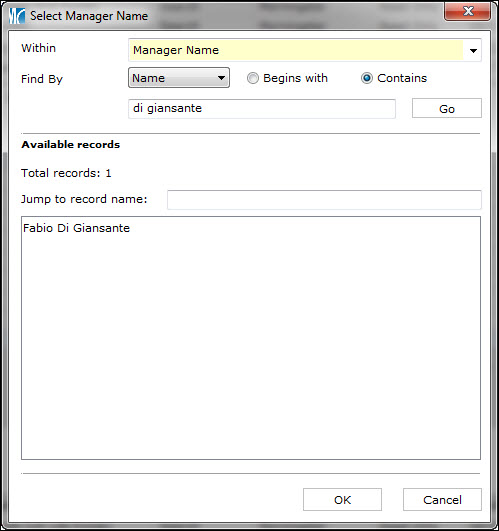
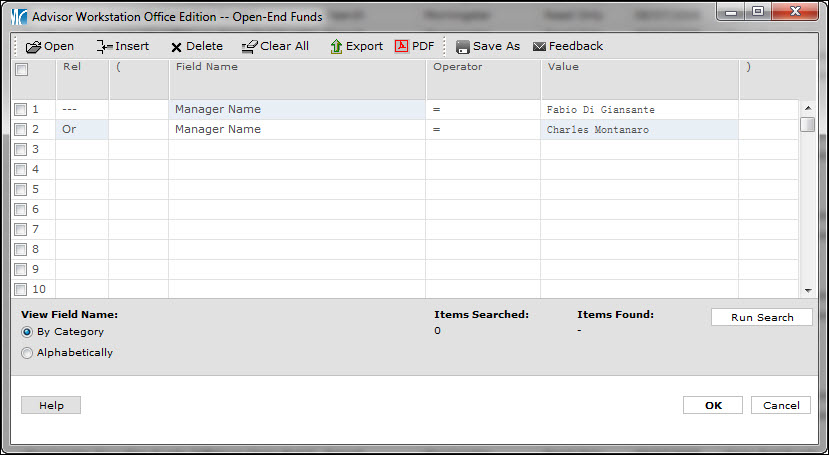
In the first row under Field Name, scroll to find Manager Name, then type in the name and click GO. Once you’ve found the manager, click OK to add the name to the search.

You can add multiple managers at once by using ‘OR’ in each row of the search.

Quick Tip: When typing the name in the Manager Name box, select ‘Contains’ instead of ‘Begins With’ to search first names and surnames.

Visit the post on Analyst ratings to see read more about the managers.

Posted in: Events, Morningstar, Press Releases, Quick Tips, Research,

Acronyms Galore: FSA’s RDR FAQs

by Caroline Gutman on 29 Feb 2012

The FSA recently published a list of FAQs from their roadshows on RDR. We’ve featured a few of them just below and have included helpful Adviser Workstation shortcuts.

**-If I consider a product, but I don’t feel comfortable recommending it due to its risky _nature, can I still call myself independent?

_**

__A firm should only hold itself out as giving independent advice if it is prepared to provide advice on all types of retail investment products that may be suitable for their clients. Such a firm may, however, after considering the market, take the view that certain retail investment products are unlikely to be suitable for their client base. If this is the case, then that firm would not need to carry out a comprehensive review of the market for these products for each of their clients. We would not expect firms when forming advice for a client to review the market for a product that would not be suitable, let alone to recommend such a product.

(Morningstar Quick Tip: Filter out any unsuitable products for your clients by building a custom filter in Adviser Workstation. See how to build a search by clicking here)


-If a firm has three advisers who give restricted advice, but as a team they can advise on all retail investment products, can the firm hold itself out as independent?

No one in a firm that holds itself out as independent should make a personal recommendation to  a retail client unless that personal recommendation is based on a comprehensive and fair analysis  of all types of retail investment products which may be suitable for that client.

(Morningstar Quick Tip: Use Morningstar Analyst Rating reports for independent, objective analysis on open-end funds, equities and investment trust funds. Click here to learn how to find the ratings)


-What is meant by relevant market in the context of independent advice?

_ **_A relevant market should comprise all retail investment products which are capable of meeting the investment needs and objectives of a retail client. To use the example of ethical products, for clients who only want these, it is clear that a range of products would never be suitable for them, namely non-ethical products. The relevant market for these clients would not include all retail investment products, but would include all ethical retail investment products. Relevant markets are defined by client needs, not by any other factor.

We expect it to be rare that an adviser could completely rule out advising on certain types of retail investment products on the basis that they will not be suitable for any of their clients, and to limit their advice to a particular relevant market. If they can identify a narrower relevant market, they should not hold themselves out as offering independent advice in a broader sense.

(Morningstar Quick Tip: Save a list of ethical and/or socially conscious funds to quickly add funds to a client’s portfolio. Click here to find out how)


Questions and responses taken from Financial Services Authority’s Finalised Guidance, February 2012. Click here to view the report and other FAQs

Posted in: IFA News and Commentary, Morningstar, Quick Tips, Research,

Morningstar UK Adviser Survey

by Caroline Gutman on 27 Feb 2012

We’d love to know your thoughts on financial advisers’ websites, whether it be your own site or those of your peers. Please take a few minutes to complete our quick survey and help us track trends and attitudes towards financial adviser websites. We’ll be presenting our findings at the Adviser Forums next month. As a thank you for your time you will be entered into a prize draw to receive one of two £100 Amazon gift vouchers.

On completing the survey, your details will be placed into the Morningstar ‘hat’ and the lucky winners will be chosen at random. Winners will be chosen from all submissions received by March 12, 2012 and announced on March 20, 2012.

Thank you for your time and good luck!

This survey is no longer active.

Posted in: Events, Morningstar,

VAT and Adviser Charging – RDR Update

by Caroline Gutman on 23 Feb 2012

HMRC have issued further draft guidance on the important issue of VAT and adviser charging under RDR.

Representations were made by interested bodies following the Draft Guidance issued last year.  The latest (revised) draft guidance note appears to offer greater reassurance of VAT freedom in relation to charges made for the services of financial advisers.

The draft anticipates that:

An adviser’s role in the retail investment market will normally involve them entering into arrangements with the customer under which they may:

1.         gather information about the customer (fact-find)

2.         carry out research to find suitable investment options

3.         provide the customer with reports, financial health-checks, forecasts

4.         recommend specific investment products to the customer, including the prices at which these can be arranged

5.         act between the product provider/s and the customer with a view to arranging the sale of the retail investment products agreed with the customer

6.         and, where applicable, ie where the customer agrees to an ongoing review service, monitor the customer’s ongoing position to ensure that the products continue to meet the requirements of the customer

Most helpfully the draft guidance appears to contemplate that where the customer has agreed to the arrangement of a retail investment product and the adviser performs the necessary services, as outlined at stages (1- ) 5 above, (regardless of whether the sale of the product is finally concluded), and they are able to evidence that they have done so, no VAT will be due on any charges made to the customer for these services.

And a similar stance, dependant on what the client has agreed in relation to the services that the adviser will deliver (including the potential arrangement of a retail investment product), is taken in relation to charges for ongoing services.

Provided by Techlink

Read more at: www.techlink.co.uk

HMRC Draft Guidance, as of February 2012

(The above HMRC Latest VAT Draft Guidance was current at time of publication. 23 February 2012)

Posted in: IFA News and Commentary,

The Rise of the US High Yield ETF

by amcdonald on 15 Feb 2012

Most successful high yield managers tell us that the key to performing well over the long term is to avoid companies that go bankrupt.  Of course, at its broadest level this is self-evident for bond investors but in an asset class where a material default rate is to be expected and where the high levels of leverage in companies can mean they unwind very quickly, it is far from easy to achieve in practice.  Those managers who can achieve a low level of “adverse credit events”, collecting sustainably high coupons from their holdings while avoiding the periodic illiquidity of the asset class, are therefore those who typically perform strongly.

These characteristics of high yield make it very dependent on a series of idiosyncratic credit risks and I am therefore surprised by the rapid rise of dedicated ETFs in the US.  Not only does blind replication clearly remove a key plank of how high yield bond managers add value (hopefully a conscious decision when selecting a pure beta strategy) but by its very nature, it is a very difficult market to replicate by sampling and yet the illiquid nature of many issues means that full index replication is costly.  This underlying illiquidity of many bonds is an increasing problem as investment banks continue to withdraw capital from fixed income markets and thus focus more and more on matching buyers and sellers.

Many ETFs, such as the SPDR Barclays Capital High Yield Bond fund attempt to address these concerns by focusing only on the most liquid issues but even here, liquidity is relative and it is noticeable that the NAV of the fund has lagged the benchmark materially over time.  Moreover, the focus on larger, liquid issuers is of course an interesting concept in the world of bonds given that it implies a greater focus on companies with a higher absolute level of debt.  This does not automatically imply higher leverage but companies with large debt burdens do at times come under particular pressure, especially if they face more regular refinancing requirements.

In the event that ETFs remain a popular way to buy high yield, a key question is how this might affect the outcome from active funds.  The most probable answer is even higher volatility in the more liquid names in the index due to the price-insensitive nature of ETF activity.  While this technical-driven volatility could create buying and selling opportunities for the more nimble managers, investors should be aware that it might at the margin make for an even bumpier return profile from what is already a volatile asset class.

Posted in: Morningstar OBSR Commentary,

Global Income – A Perfect Partnership?

by Caroline Gutman on 09 Feb 2012

Live Wednesday, February 22, 1pm – 2pm or afterwards on demand

In the current economic climate of low interest rates and low or even negative returns, income funds are fast becoming the must-haves. In this free online webinar, a panel of global equity experts will be talking about where they’re seeing compelling opportunities for growing income; why it is that their investment trusts have been able to deliver steady, predictable income growth for their shareholders; and why global income isn’t just a passing phase.

Attend here: http://www.brighttalk.com/r/TkD

This session will be moderated by Jackie Beard, Director Closed-end Fund Research, Morningstar who will be leading the discussion alongside:

  • Bruce Stout, Senior Investment Manager, Aberdeen Asset Management
  • Peter Hewitt, Director, Global Equities at F&C Asset Management, F&C Investments
  • James de Sausmarez, Director and Head of Investment Trusts, Henderson
  • John Baker, Joint Fund Manager of J.P. Morgan Income and Capital Trust, J.P. Morgan Income and Growth Trust and J.P. Morgan Elect Managed Income

If you are unable to join any the live event, you can watch on demand immediately afterwards. During the live event you will be able to submit questions to the panel and take part in audience votes.

Posted in: Events, IFA News and Commentary, Morningstar, Research,

An Investment Process

by Caroline Gutman on 06 Feb 2012

(Guest post by Ian Holdsworth, Managing Director of Financial Solutions SC Limited)

With RDR, qualifications, segmentation etc as well as trying to run a profitable company it has been extremely helpful to find a company that will free up more of my time to enable my company to give expert investment advice based on thorough research rather than a managed fund or a “flavour of the day”.

Although the majority of my investments are held on platform or within a SIPP there has been in the past very little in the way of independent portfolio tools that can help build a diversified portfolio based on attitude to risk and asset allocation.

Morningstar offers an in-depth solution with their Adviser Workstation that has no bias towards particular funds or companies and more importantly gives in depth research into each fund selected. It is then possible to build a model portfolio based on risk and asset allocation that are all shown on their system. This ensures that no sector is over or underweight and that the portfolios can be rebalanced.

I would have to say it is not the most user-friendly system but it is certainly worth the while to spend time learning how it works and ensuring it fits in with your company requirements. The team at Morningstar could not have been more helpful though in helping me understand the system.

With the latest paper from the FSA looking into how IFAs recommend funds and put together portfolios I feel this would be an ideal solution to that issue.

Ian Holdsworth is Managing Director of Financial Solutions SC Limited, an FSA-registered financial advisery firm based in Southend-on-Sea, Essex.

If you would like to contribute to this blog, please email your submission to: adviser@morningstar.co.uk with subject line “Blog post”

Posted in: IFA News and Commentary, Morningstar,